Greenhouse Gases
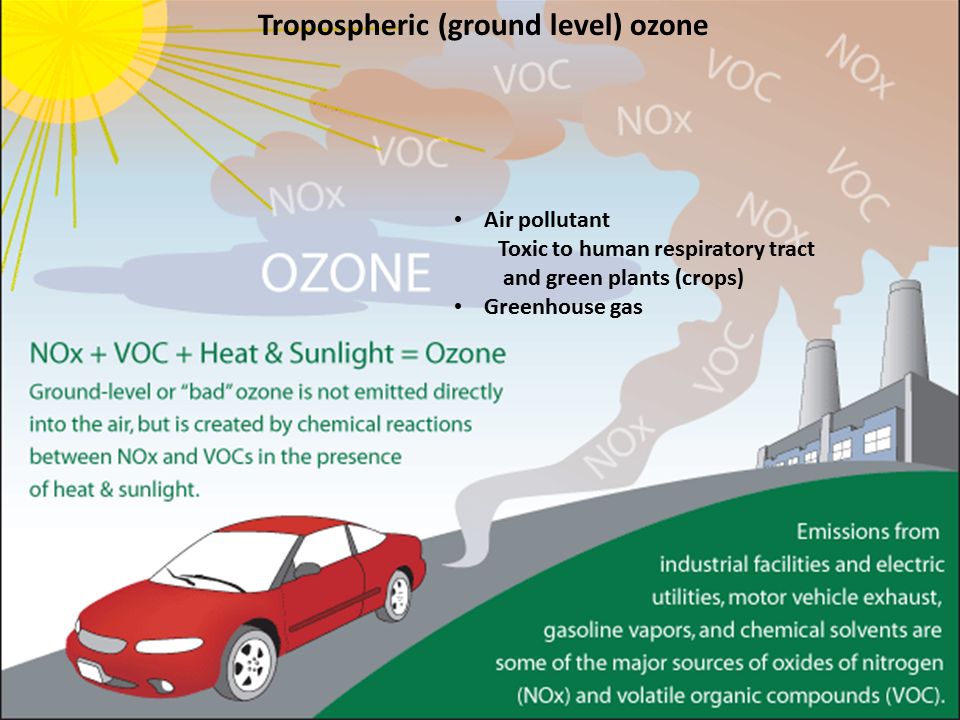
Tropospheric ozone ((ground level, or surface ozone) is a
short lived greenhouse gas and a well known toxic air
pollutant caused by fossil fuel combustion.
Toxic ground level ozone (distinct from
stratospheric ozone that is the UV radiation shield) is
a short lasting GHG.
It is formed by a chemical reaction between oxides of nitrogen
and volatile organic compounds (both from fossil fuels)
which is catalyzed by solar warmth.
It therefore increases with global warming.
As well as being toxic to human health, it is toxic to green plants, that absorb CO2 by photosynthesis. Increased surface ozone will decrease green plant capacity absorb CO2, a +ve amplifying feedback.
CFCs and HCFCs are synthetic chemicals used in industry.
They are part of a group of such chemicals called F-gases by the IPCC, which includes the most potent and most long-lived of all the GHGs.
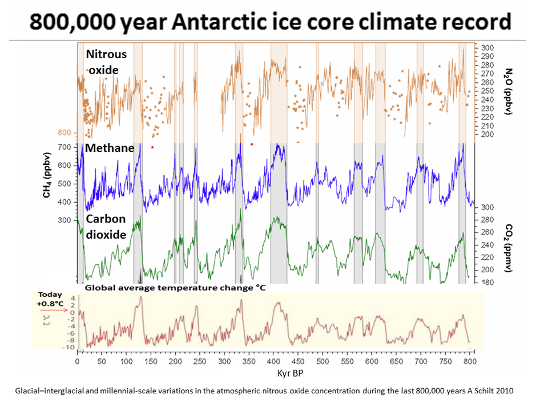
Ice core data of CO2, methane, and nitrous oxide atmospheric concentrations goes back 800,000 years.
This shows that Aatmospheric CO2 is over 30% higher than its maximum level (300 ppm) over the past 800,000 years, from the ice core data.
pollutant caused by fossil fuel combustion.
Toxic ground level ozone (distinct from
stratospheric ozone that is the UV radiation shield) is
a short lasting GHG.
It is formed by a chemical reaction between oxides of nitrogen
and volatile organic compounds (both from fossil fuels)
which is catalyzed by solar warmth.
It therefore increases with global warming.
As well as being toxic to human health, it is toxic to green plants, that absorb CO2 by photosynthesis. Increased surface ozone will decrease green plant capacity absorb CO2, a +ve amplifying feedback.
CFCs and HCFCs are synthetic chemicals used in industry.
They are part of a group of such chemicals called F-gases by the IPCC, which includes the most potent and most long-lived of all the GHGs.
Ice core data of CO2, methane, and nitrous oxide atmospheric concentrations goes back 800,000 years.
This shows that Aatmospheric CO2 is over 30% higher than its maximum level (300 ppm) over the past 800,000 years, from the ice core data.
CO2.
Of all the GHG emissions CO2 has contributed more than 60% of global warming.
Because it has a very long atmospheric lifetime, CO2 emissions are highly persistent and therefore cumulative in the atmosphere.
The IPCC gives no set metric on CO2 for atmospheric lifetime.The CDIAC assigned 100-300 years to CO2, but the big thing is that 20-40% of CO2 emissions last for 1000 years.
In fact it takes over 100,000 years for emitted CO2 to be removed from the atmosphere by natural processes.
CO2 is also especially important as the sole cause of ocean acidification.
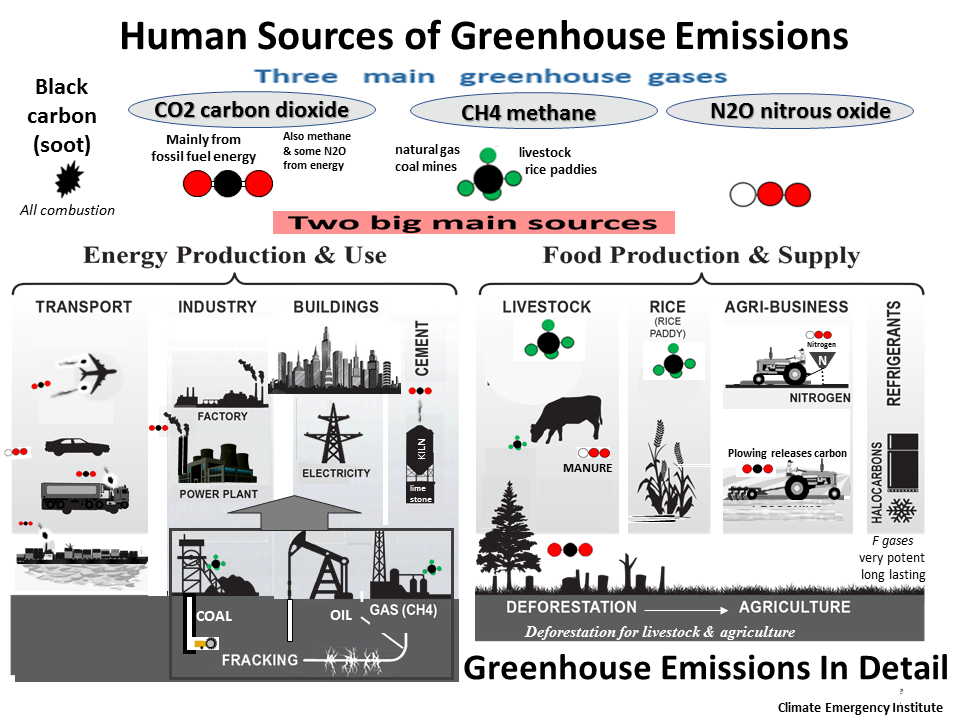
The main CO2 sources are fossil fuel energy, deforestation and cement manufacturing (heating limestone).
Atmospheric CO2 is the highest in 14 million years
CH4 Methane is classified by the IPCC as a long lived GHG. Methane's global warming contribution is 30% from preindustrial times.
Methane lasts in the atmosphere 12 years, over which time methane emissions exert a warming 100 times that of CO2 over its lifetime, not the 25 times CO2 deferred over 100 years, which is generally used.
In addition methane disappears because it is oxidized to other GHGs - including water vapour, and CO2 (that is not accounted in the methane GWP.
Main methane sources are livestock (ruminants exhale methane), natural gas industry (esp fracking), coal mining, natural wetlands, and rice paddies (artificial wetlands).
A special feature of methane is, the more of it there is in the atmosphere - the longer methane will last in the atmosphere, because its breakdown slows down.
Methane feedback. The biggest thing about methane now is that we are into methane feedback.
Atmospheric methane increase levelled off at 2000, but since 2007 it has been on a sustained fast increase, that the scientists say is due in part to methane feedback emissions from the warming planet. The feedback sources are warming subarctic and tropical peatlands (wetland peat).
Nitrous oxide (N2O) Nitrous oxide contributes the least of these 3 GHGs to global warming, but is increasing fast.
It has both an extreme long life time (114 years) and high GWP (298 over 100 years).
The main sources are nitrogen chemical fertilizer (made from natural gas), livestock feed production ( same reason), livestock waste, and sewage.
Nitrous oxide is even more important now because it is the main cause of depletion affecting the stratospheric ozone UV protective layer
Of all the GHG emissions CO2 has contributed more than 60% of global warming.
Because it has a very long atmospheric lifetime, CO2 emissions are highly persistent and therefore cumulative in the atmosphere.
The IPCC gives no set metric on CO2 for atmospheric lifetime.The CDIAC assigned 100-300 years to CO2, but the big thing is that 20-40% of CO2 emissions last for 1000 years.
In fact it takes over 100,000 years for emitted CO2 to be removed from the atmosphere by natural processes.
CO2 is also especially important as the sole cause of ocean acidification.
The main CO2 sources are fossil fuel energy, deforestation and cement manufacturing (heating limestone).
Atmospheric CO2 is the highest in 14 million years
It is increasing at an unprecedented rate in tens of millions of years
Multiple lines of evidence show that the rate at which CO2 has increased in the atmosphere during 1900–2019 is at least 10 times faster than at any other time during the last 800,000 years (high confidence), and 4–5 times faster than during the last 56 million years. IPCC AR6 WG1 {5.1.1, 2.2.3; Figures 5.3, 5.4; Cross-Chapter Box 2.1}
CO2 equivalent CO2e
All the GHGs (as a bundle) are calculated and expressed as CO2 equivalent.
CO2 equivalent CO2e
All the GHGs (as a bundle) are calculated and expressed as CO2 equivalent.
CO2e therefore is much higher than CO2.
It is essential to control all GHGs in mitigation, so therefore the IPCC uses CO2e.
The 1992 UN climate change convention stipulates atmospheric greenhouses gases for climate change monitoring and control, not only global warming.
NOAA publishes its Annual Greenhouse Gas Index, that gives atmospheric CO2 equivalent and radiative forcing
The 1992 UN climate change convention stipulates atmospheric greenhouses gases for climate change monitoring and control, not only global warming.
NOAA publishes its Annual Greenhouse Gas Index, that gives atmospheric CO2 equivalent and radiative forcing
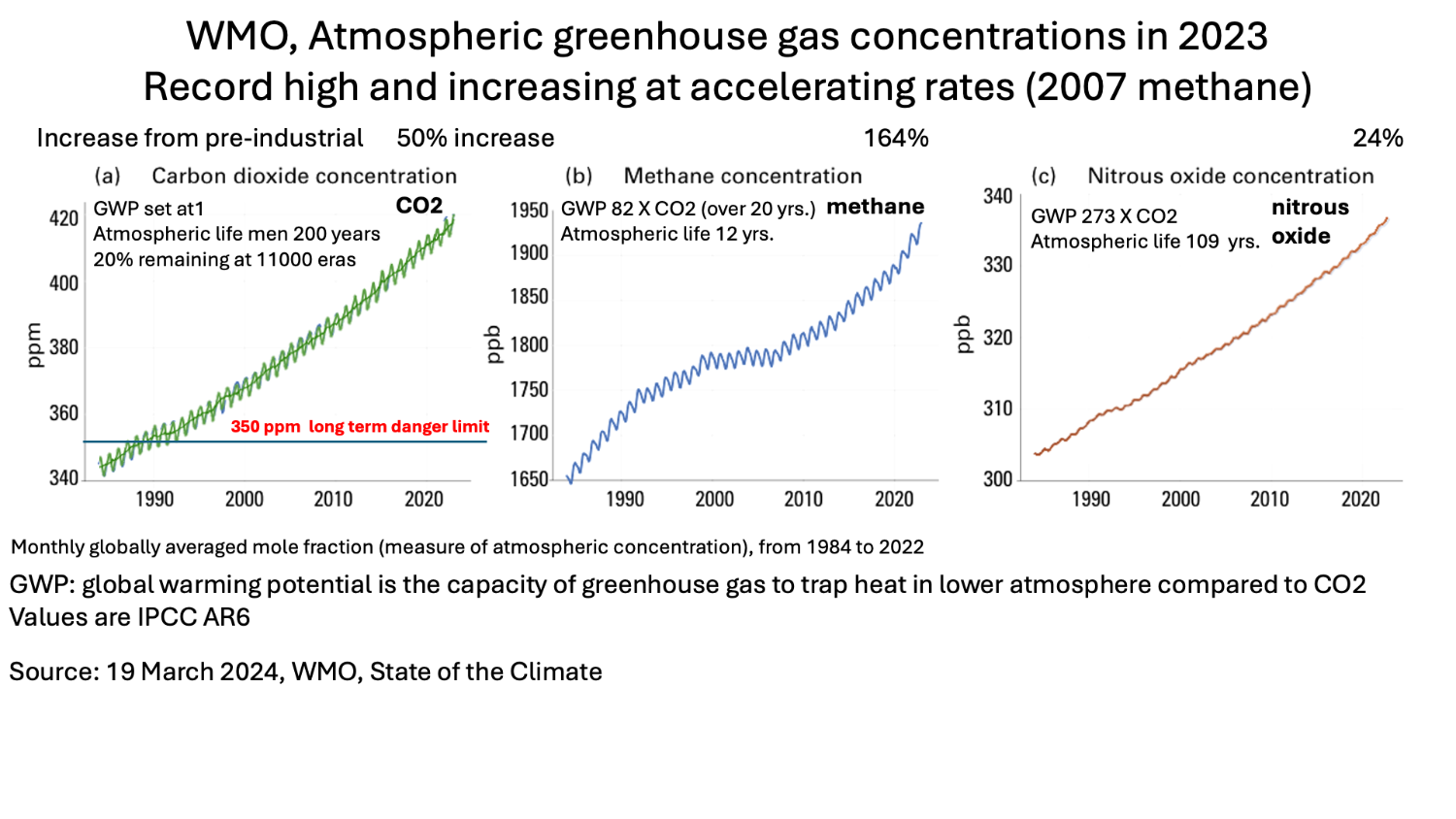
2024 atmospheric CO2 at 423.9 ppm has increased 52% above pre-industrial
Methane at 1942 ppb has increased 166%, by a factor of 2.66
Nitrous oxide at 338 ppb has increased 25%
CH4 Methane is classified by the IPCC as a long lived GHG. Methane's global warming contribution is 30% from preindustrial times.
Methane lasts in the atmosphere 12 years, over which time methane emissions exert a warming 100 times that of CO2 over its lifetime, not the 25 times CO2 deferred over 100 years, which is generally used.
In addition methane disappears because it is oxidized to other GHGs - including water vapour, and CO2 (that is not accounted in the methane GWP.
Main methane sources are livestock (ruminants exhale methane), natural gas industry (esp fracking), coal mining, natural wetlands, and rice paddies (artificial wetlands).
A special feature of methane is, the more of it there is in the atmosphere - the longer methane will last in the atmosphere, because its breakdown slows down.
Methane feedback. The biggest thing about methane now is that we are into methane feedback.
Atmospheric methane increase levelled off at 2000, but since 2007 it has been on a sustained fast increase, that the scientists say is due in part to methane feedback emissions from the warming planet. The feedback sources are warming subarctic and tropical peatlands (wetland peat).
Nitrous oxide (N2O) Nitrous oxide contributes the least of these 3 GHGs to global warming, but is increasing fast.
It has both an extreme long life time (114 years) and high GWP (298 over 100 years).
The main sources are nitrogen chemical fertilizer (made from natural gas), livestock feed production ( same reason), livestock waste, and sewage.
Nitrous oxide is even more important now because it is the main cause of depletion affecting the stratospheric ozone UV protective layer
The WMO publishes its Greenhouse Gas Bulletin annually for atmospheric concentrations
Atmospheric GHG levels unprecedented in the past 800,000 years
They are is still increasing, because their emissions are still being increased
They are is still increasing, because their emissions are still being increased
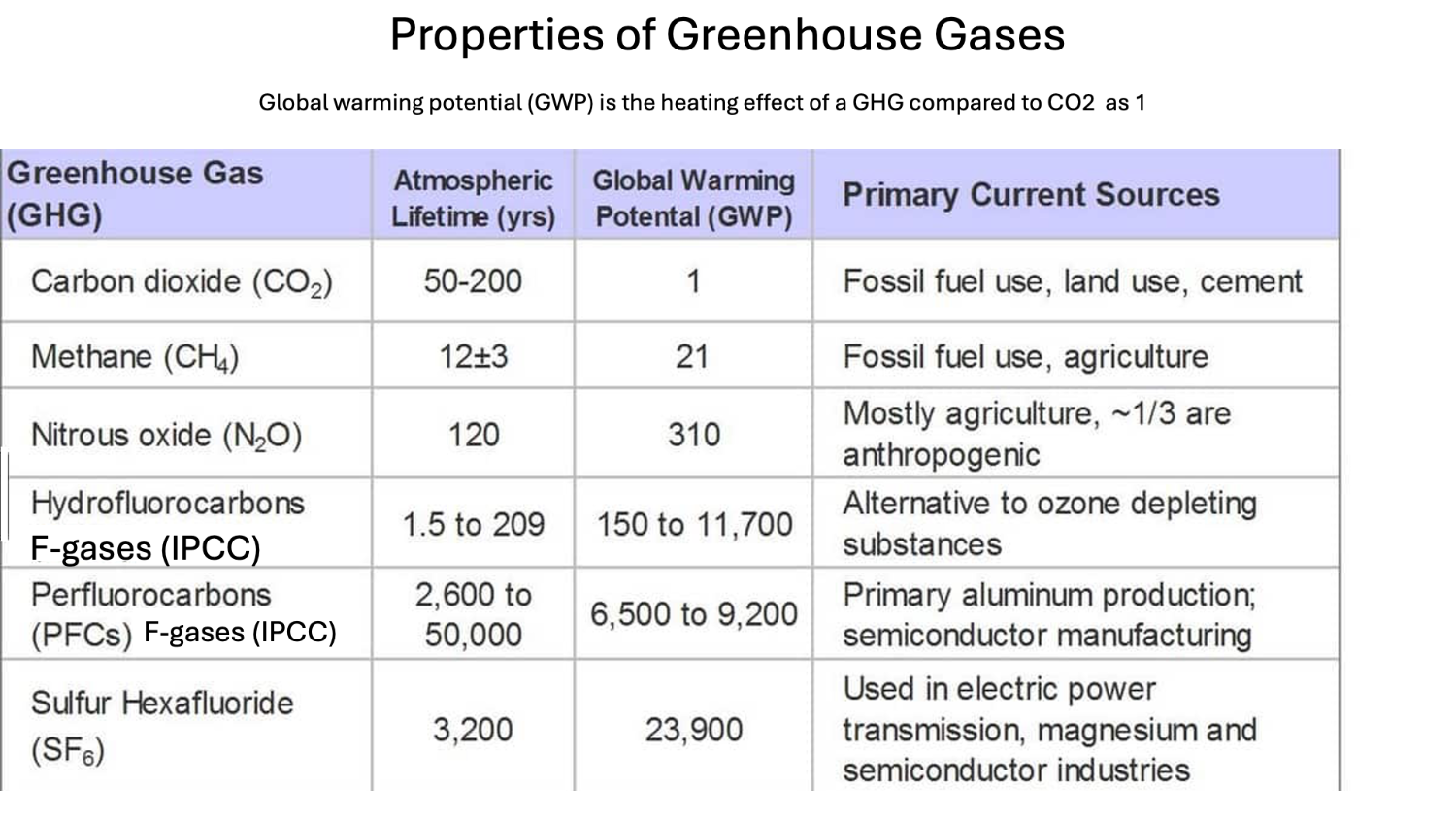
The three main GHGs have different atmospheric lifetimes and different global warming capacities (global warming potential GWP).


Climate Emergency Institute
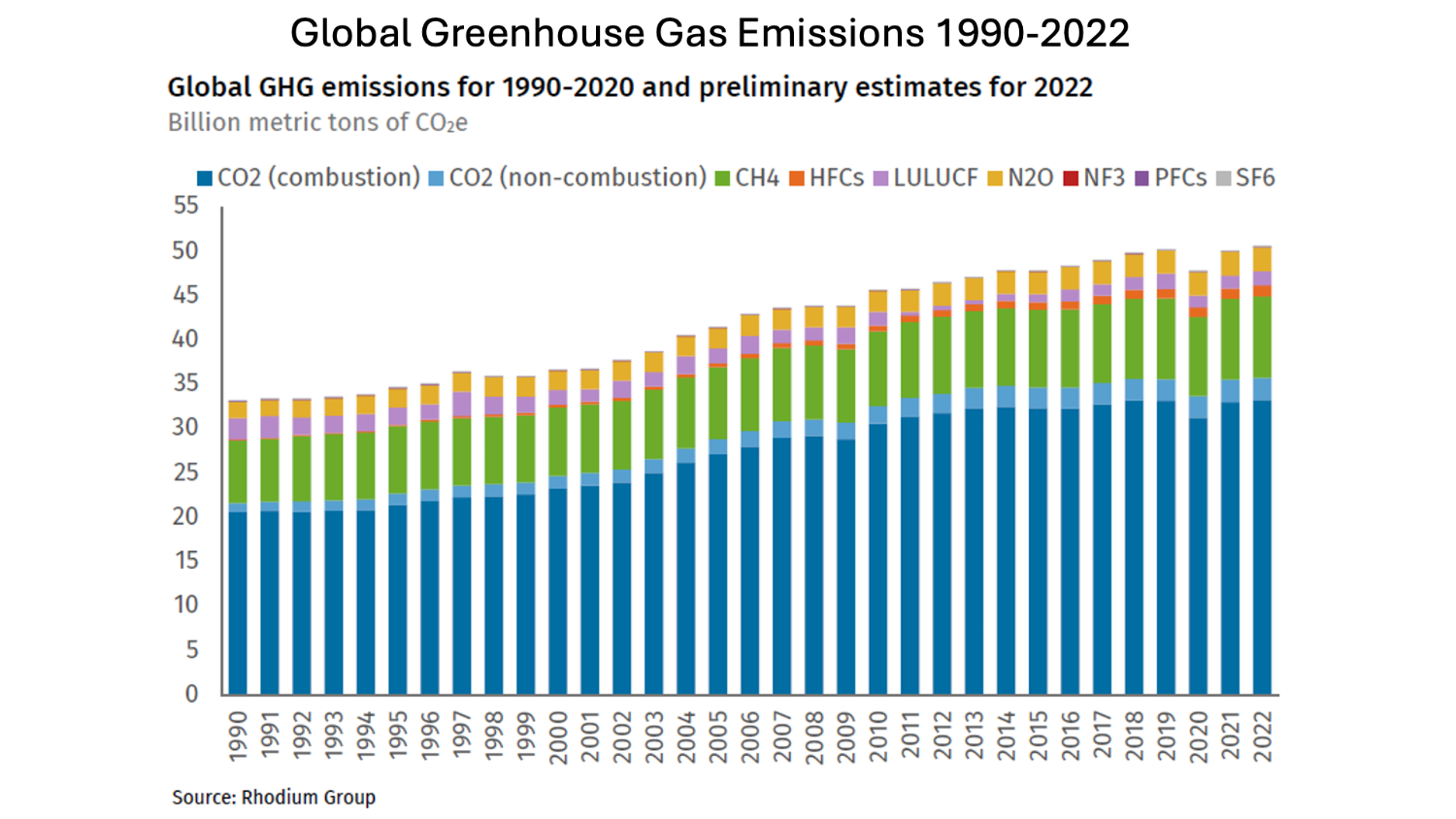
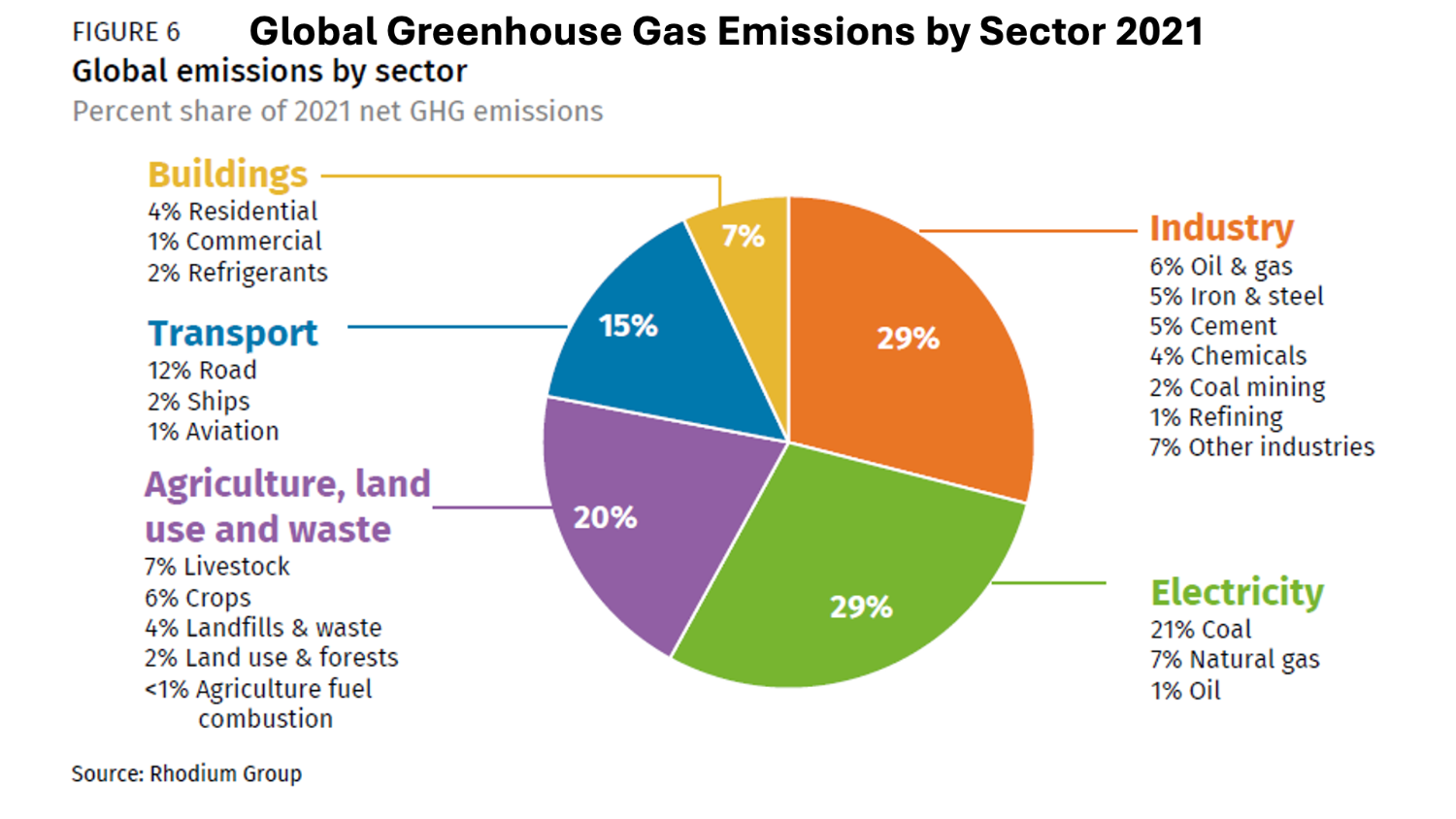
Global CO2 emissions by sector
GHGs over geological time
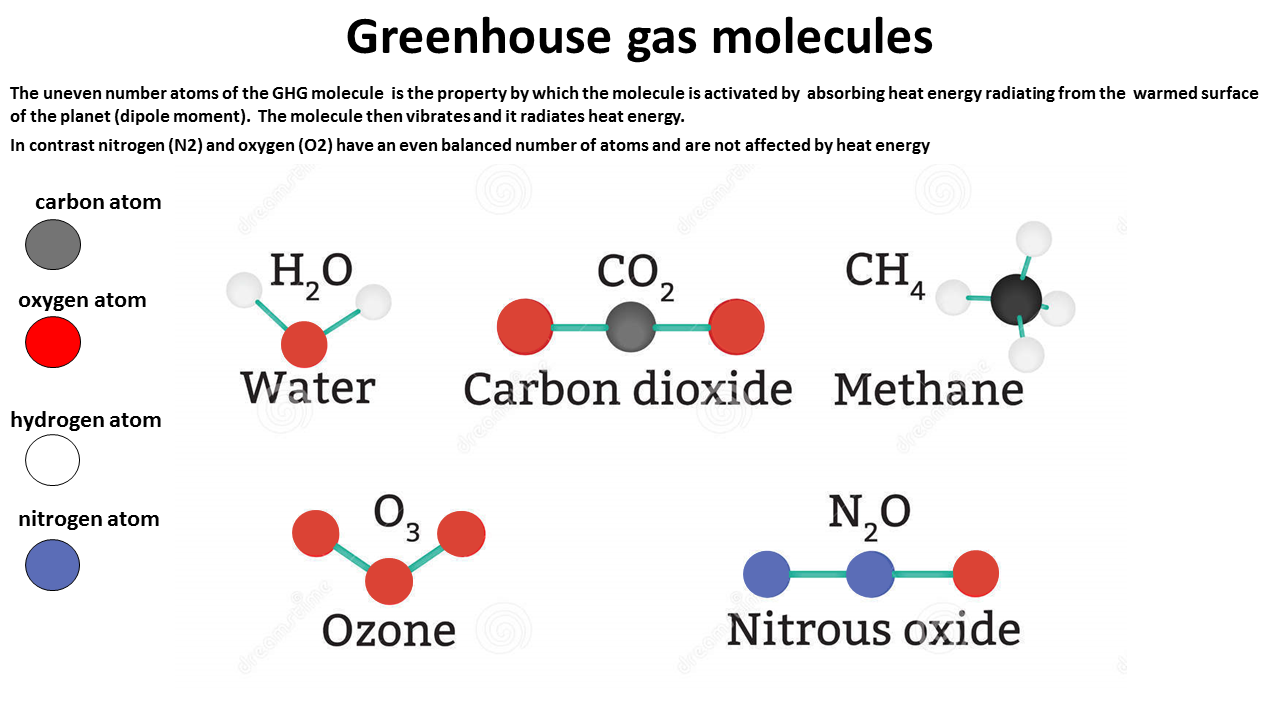
The three main GHGs being emitted causing global warming-occur naturally. Ice cores show how they rise and fall alternating with ice ages warm periods. They are carbon dioxide (CO2), methane (CH4) and nitrous oxide (N2O).
They are classified by the IPCC as 'long lived' atmospheric GHGs, lasting from about a decade (CH4) to over a century (CO2 & N2O).
The three main GHGs being emitted causing global warming-occur naturally. Ice cores show how they rise and fall alternating with ice ages warm periods. They are carbon dioxide (CO2), methane (CH4) and nitrous oxide (N2O).
They are classified by the IPCC as 'long lived' atmospheric GHGs, lasting from about a decade (CH4) to over a century (CO2 & N2O).
Water vapour is the top GHG for warming contribution, because it is so abundant in the atmosphere. It is classified by the IPCC as a warming feedback,its most important capacity, rather than a GHG emission. Warmer air/atmosphere holds more water vapour. This +ve (amplifying) feedback about doubles the warming of a GHG alone.
The other GHGs are classified as trace gases only existing in parts per million (CO2) or per billion (methane, nitrous oxide) of air.
The other GHGs are classified as trace gases only existing in parts per million (CO2) or per billion (methane, nitrous oxide) of air.