Food Production Decline- Failure
All extreme weather events are damaging to crops
o Heat waves
o Drought
o Fires
o Torrential rains
o Floods- may be damaging to
the soil as well (water-logged)
As temperatures increase, the crops tolerance to heat is exceeded and yields decline
Already, with more heat waves this has resulted in shocks to yields, in all major food producing regions
The rapid increase in Northern hemisphere warming and extreme weather threatens global catastrophe because all the world's best food producing regions are in the Northern hemisphere.
Climate change prolonged extreme droughts have affected the US great grain belt region, Europe, China and South America.
This northern hemisphere extreme weather is being exacerbated by the rapid loss of Arctic albedo cooling (melt sea ice and snow) impacting on top of NH warming.
Scientists have called the Arctic summer sea ice 'the air conditioner of the entire Northern hemisphere'. This air conditioning affect is from Arctic albedo cooling as a whole. The Far North snow provides about half the NH albedo cooling influence and is most important with respect to increasing NH drought.
The loss of Arctic sea ice is altering the jet stream and this is increasing extreme weather events in the northern hemisphere. It has a blocking effect on the weather prolonging the extremes (research by Jennifer Francis).
All extreme weather events are damaging to crops
o Heat waves
o Drought
o Fires
o Torrential rains
o Floods- may be damaging to
the soil as well (water-logged)
As temperatures increase, the crops tolerance to heat is exceeded and yields decline
Already, with more heat waves this has resulted in shocks to yields, in all major food producing regions
The rapid increase in Northern hemisphere warming and extreme weather threatens global catastrophe because all the world's best food producing regions are in the Northern hemisphere.
Climate change prolonged extreme droughts have affected the US great grain belt region, Europe, China and South America.
This northern hemisphere extreme weather is being exacerbated by the rapid loss of Arctic albedo cooling (melt sea ice and snow) impacting on top of NH warming.
Scientists have called the Arctic summer sea ice 'the air conditioner of the entire Northern hemisphere'. This air conditioning affect is from Arctic albedo cooling as a whole. The Far North snow provides about half the NH albedo cooling influence and is most important with respect to increasing NH drought.
The loss of Arctic sea ice is altering the jet stream and this is increasing extreme weather events in the northern hemisphere. It has a blocking effect on the weather prolonging the extremes (research by Jennifer Francis).
THEORY Predicts thatincreasing GHGs increases global warming, heat waves, drought, wildfires, storms and floods.
It was always predictable by the basic science that constant atmospheric GHG pollution, with increasing GHGs in the atmosphere, would lead to increased extreme weather. Global warming will increase extreme heat leading to increased drought, which together will increase the risk of wildfires. Global warming increases atmospheric water vapor because warm air holds more water vapor, and water vapor feedback increases warming.
In fact it has been long established that for every one degree C of warming the air will hold 7% more water (the Clausius–Clapeyron equation).
The increased GHG heat in the lower atmosphere increases lower atmosphere energy energizing of the hydrological cycle, leading to stronger winds, more heavy rains and flooding.
The strength of cyclonic storms, such as hurricanes, is increased by increased lower atmosphere energy and surface ocean warming.
As global warming increases, climate extremes increase along with the average temperature and climate. The most obvious is heat waves.
Global warming has so far significantly increased extreme heat events.
Computer models studies confirm that as global warming rises so will heat waves. By 2040 the areas affected will have increased several fold, and we are committed to this by climate system inertia.
It was always predictable by the basic science that constant atmospheric GHG pollution, with increasing GHGs in the atmosphere, would lead to increased extreme weather. Global warming will increase extreme heat leading to increased drought, which together will increase the risk of wildfires. Global warming increases atmospheric water vapor because warm air holds more water vapor, and water vapor feedback increases warming.
In fact it has been long established that for every one degree C of warming the air will hold 7% more water (the Clausius–Clapeyron equation).
The increased GHG heat in the lower atmosphere increases lower atmosphere energy energizing of the hydrological cycle, leading to stronger winds, more heavy rains and flooding.
The strength of cyclonic storms, such as hurricanes, is increased by increased lower atmosphere energy and surface ocean warming.
As global warming increases, climate extremes increase along with the average temperature and climate. The most obvious is heat waves.
Global warming has so far significantly increased extreme heat events.
Computer models studies confirm that as global warming rises so will heat waves. By 2040 the areas affected will have increased several fold, and we are committed to this by climate system inertia.
Extreme Weather
Basic climate science makes increasing extreme events certain
Obviously global surface warming increase heat waves.
Global warming increases drought particularly in already drier regions.
If heat is extreme enough it causes drought by evaporating surface and soil moisture.
Global warming increases atmospheric water vapor (warm air holds more water vapor) while the energizing of the hydrological cycle (heat is energy) leads to stronger winds, more heavy rains and flooding. The strength of tropical cyclone-type storms, such as hurricanes, is increased.
As global warming increases, climate extremes are increasing along with the average temperature and climate, and will continue to do so so long as global emissions are not put into decline .
Obviously global surface warming increase heat waves.
Global warming increases drought particularly in already drier regions.
If heat is extreme enough it causes drought by evaporating surface and soil moisture.
Global warming increases atmospheric water vapor (warm air holds more water vapor) while the energizing of the hydrological cycle (heat is energy) leads to stronger winds, more heavy rains and flooding. The strength of tropical cyclone-type storms, such as hurricanes, is increased.
As global warming increases, climate extremes are increasing along with the average temperature and climate, and will continue to do so so long as global emissions are not put into decline .
Examples of extreme weather include both the drought and the flooding in Colorado in the summer of 2013. As this article by Climate Central's Andrew Freedman makes clear, 2013 was one of the drier years on record, an important factor in the huge, record-setting wildfires seen in that state over the summer. Then, one extreme suddenly shifted into the other, dropping half of Colorado's average annual rainfall in just a few days. Mr. Freedman's article does a good job of explaining the unusual weather conditions that caused the flood, as well as the relationship between this specific weather event and climate change. A ClimateProgress article by Katie Valentine brings home the severity of the Colorado floods very well.
Jeff Masters' summary of the extreme weather events across the globe in 2010 is available from Wunderground. He does a good job of putting that strange year in the context of climate change as well.
Jeff Masters' summary of the extreme weather events across the globe in 2010 is available from Wunderground. He does a good job of putting that strange year in the context of climate change as well.
2014
31 March 2022 BAMS Explaining Extreme Events of 2020 from a Climate Perspective
UN Climate Change News, 3 May 2018 The World Health Organization (WHO) has warned that records for extreme weather events are being broken at an unprecedented rate, and that there is a real risk for the world to lose its capacity to sustain human life if the Earth’s climate is further altered by adding ever more heat-trapping greenhouse gases.
FOREST FIRES The IPCC includes forest fires under extreme weather events
FOREST FIRES The IPCC includes forest fires under extreme weather events
The Watchers. Severe Weather Earth news & Wild fires

Climate Emergency Institute
Interactive map Attributing extreme weather to climate change
2020 Hotspots of extreme heat under global warming (actual temperatures)
16 Dec 2021 Killer heat Waves and Floods Text and Photos (PDF)
IPCC AR6 WG1 Extremes Full PDF All increasing & attributed to climate change
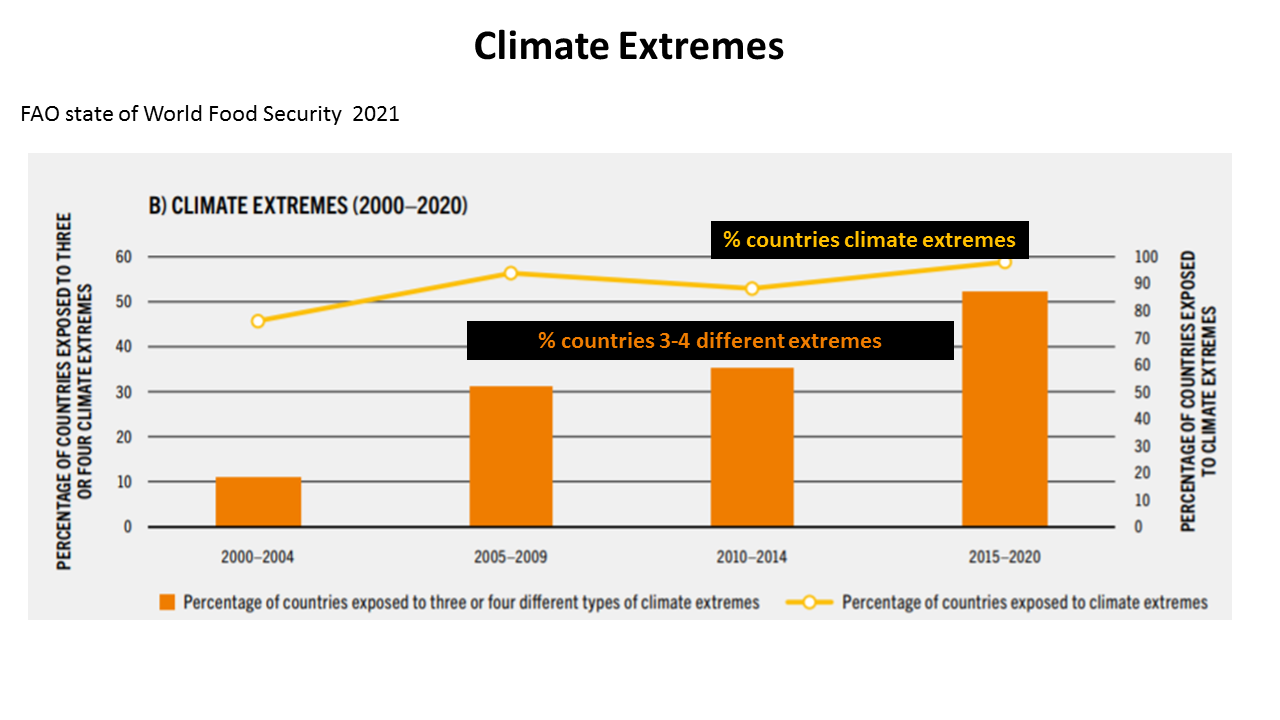
Extreme weather is most damaging to human populations and their crops, and damages ecosystems.
March 2023, Matias Heino, Probability of hot and dry weather extremes during the growing season threatens global crop yields
March 2023, Matias Heino, Probability of hot and dry weather extremes during the growing season threatens global crop yields
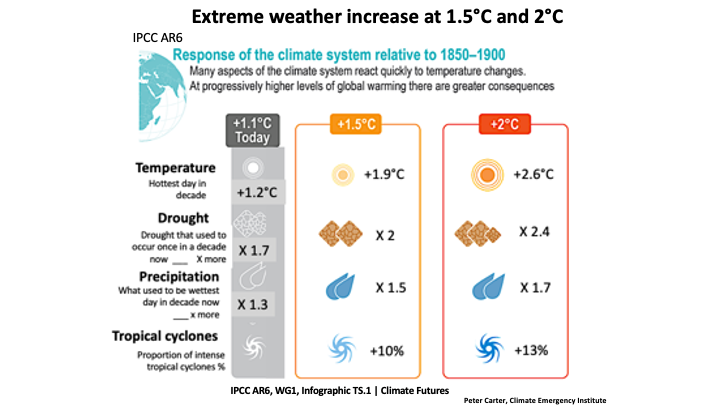
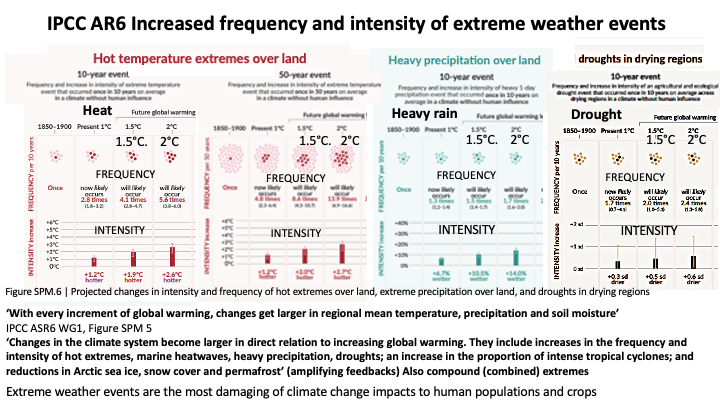
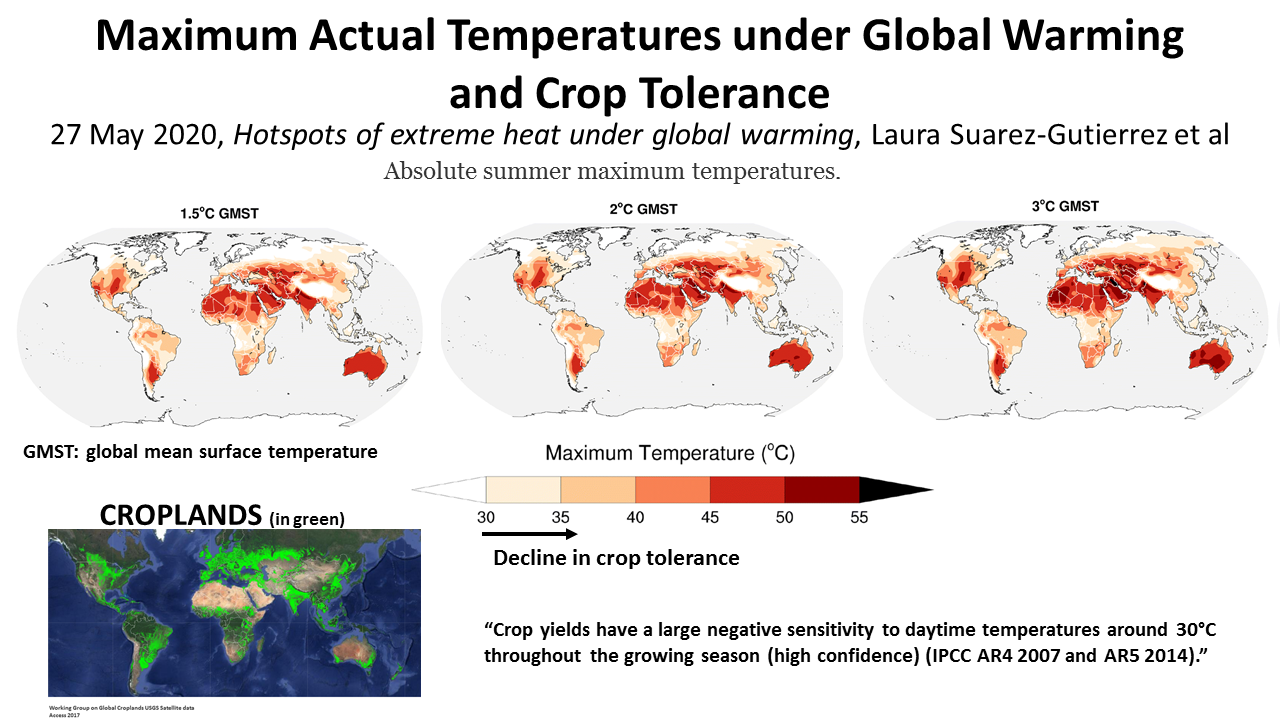
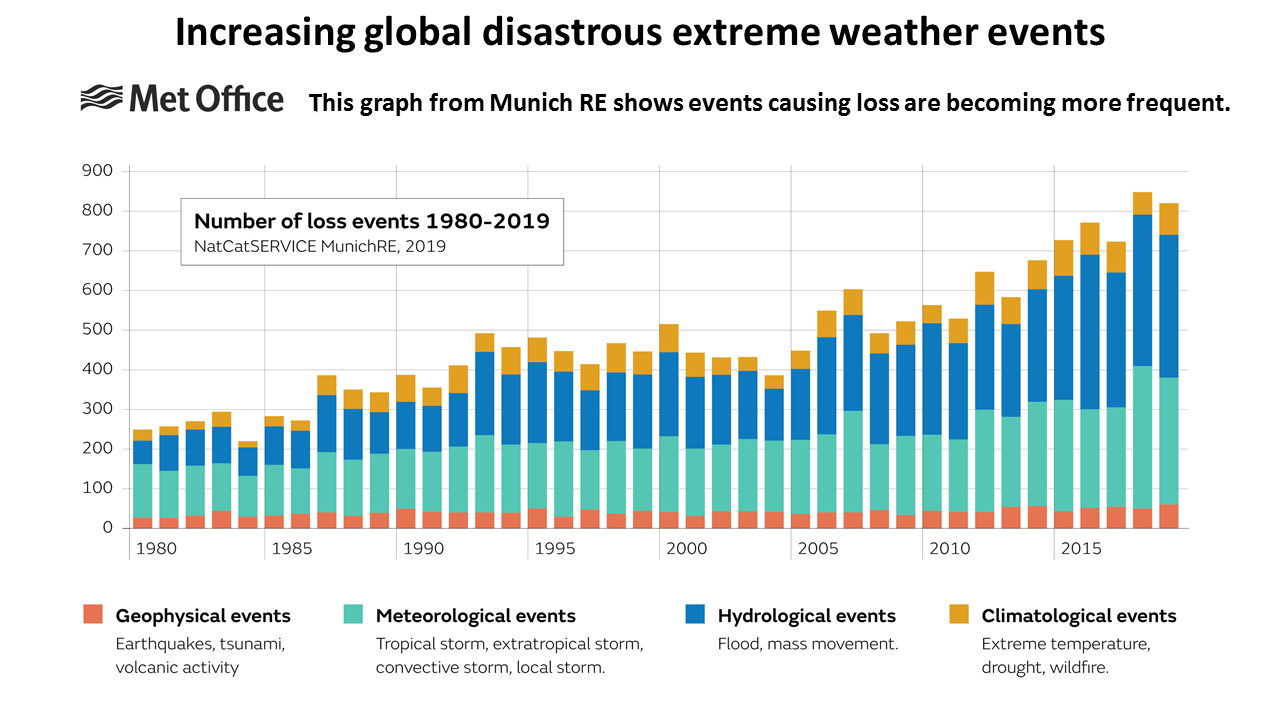
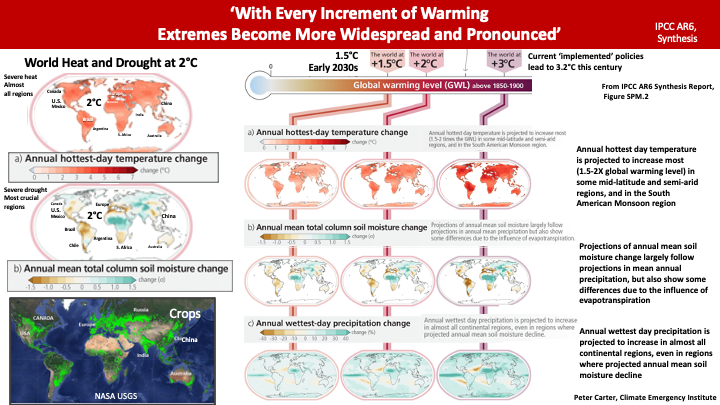
Most damaging impact to populations and to crops
Unprecedented and increasing extreme events on all continents, already.
Unprecedented and increasing extreme events on all continents, already.
IPCC 6th Assessment

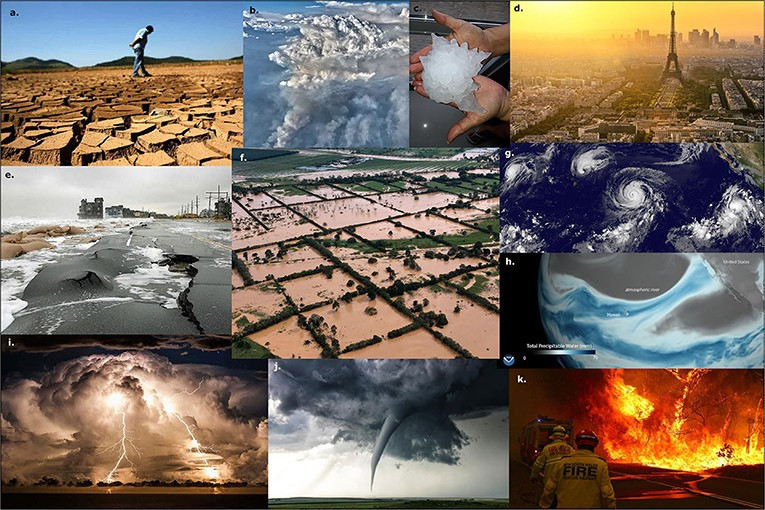
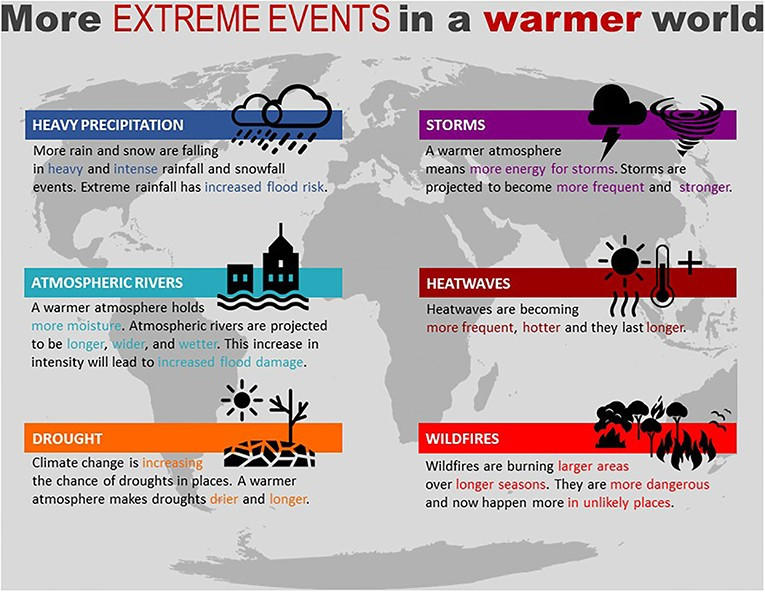
Explainer of IPCC on extremes by Carbon Brief 10 August 2021
What the new IPCC report says about extreme weather
and climate change
and climate change
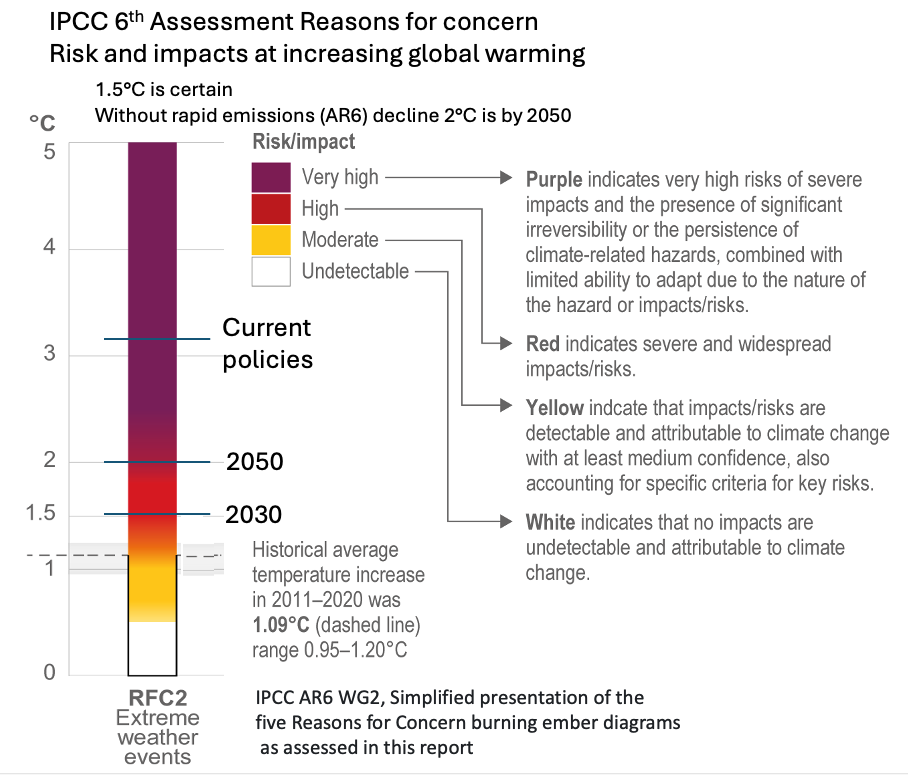
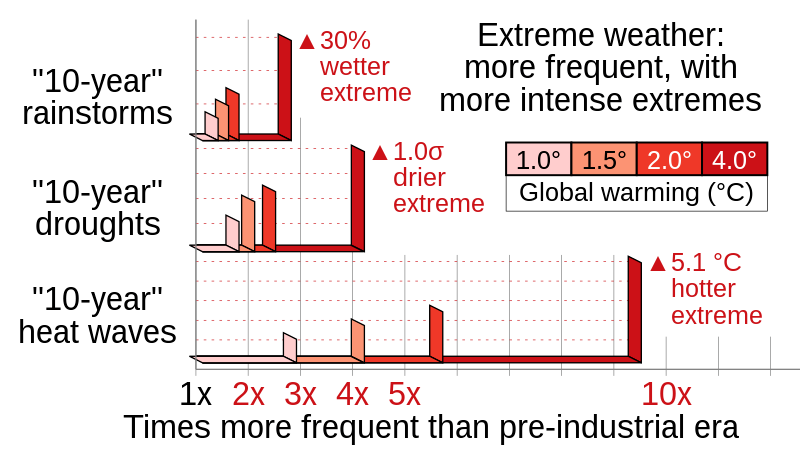
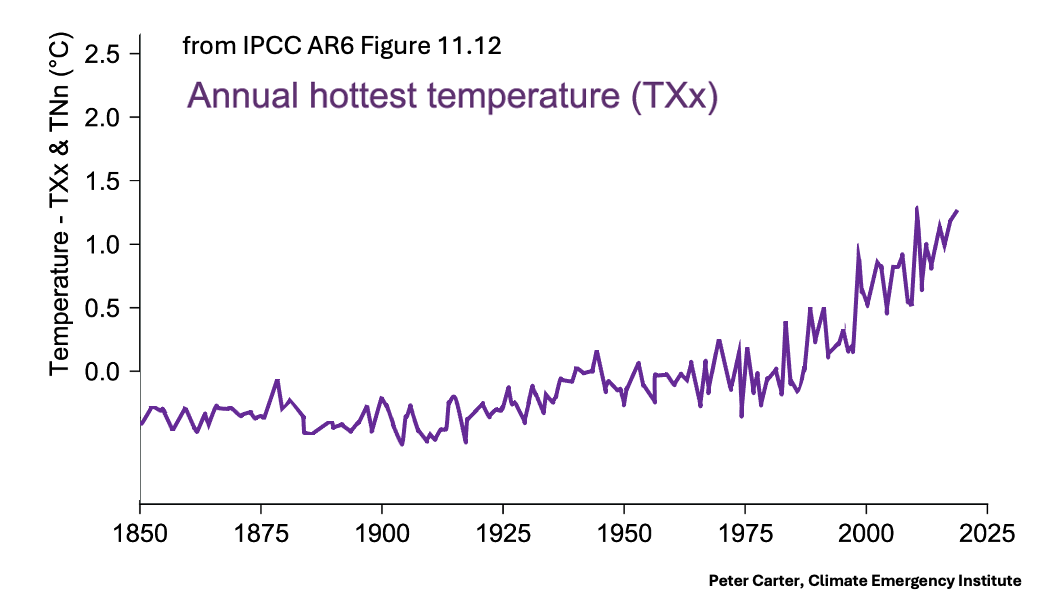
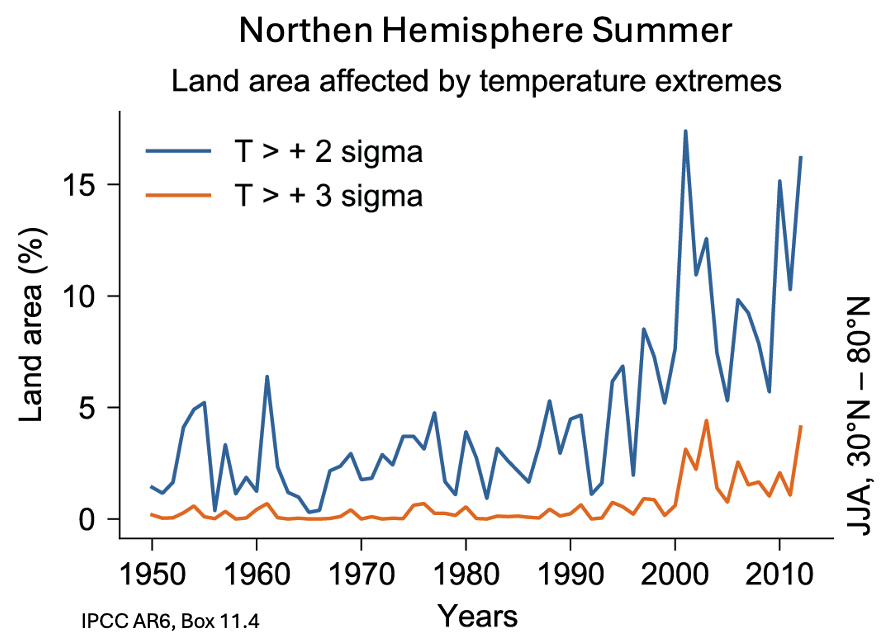
Climate change is increasing extreme weather events in all countries
2026 Super El Niño likely devastating (Nature, Editorial, 9 June 2026) El Niño is here, NOAA, Prediction Center , 11 June, 63% one of strongest.
2022, Rogers, 6-fold Increase in N. Hemisphere Concurrent Large Heatwaves Driven by Warming...
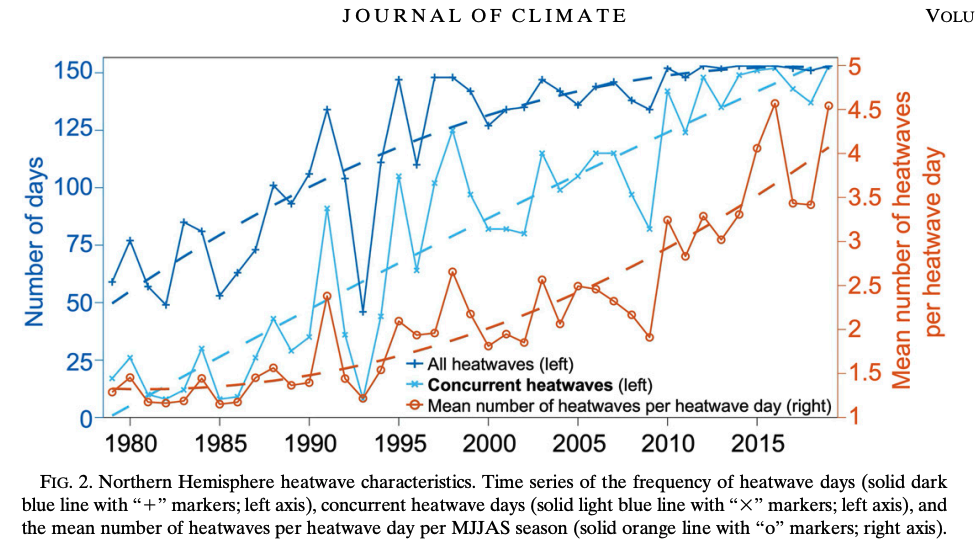
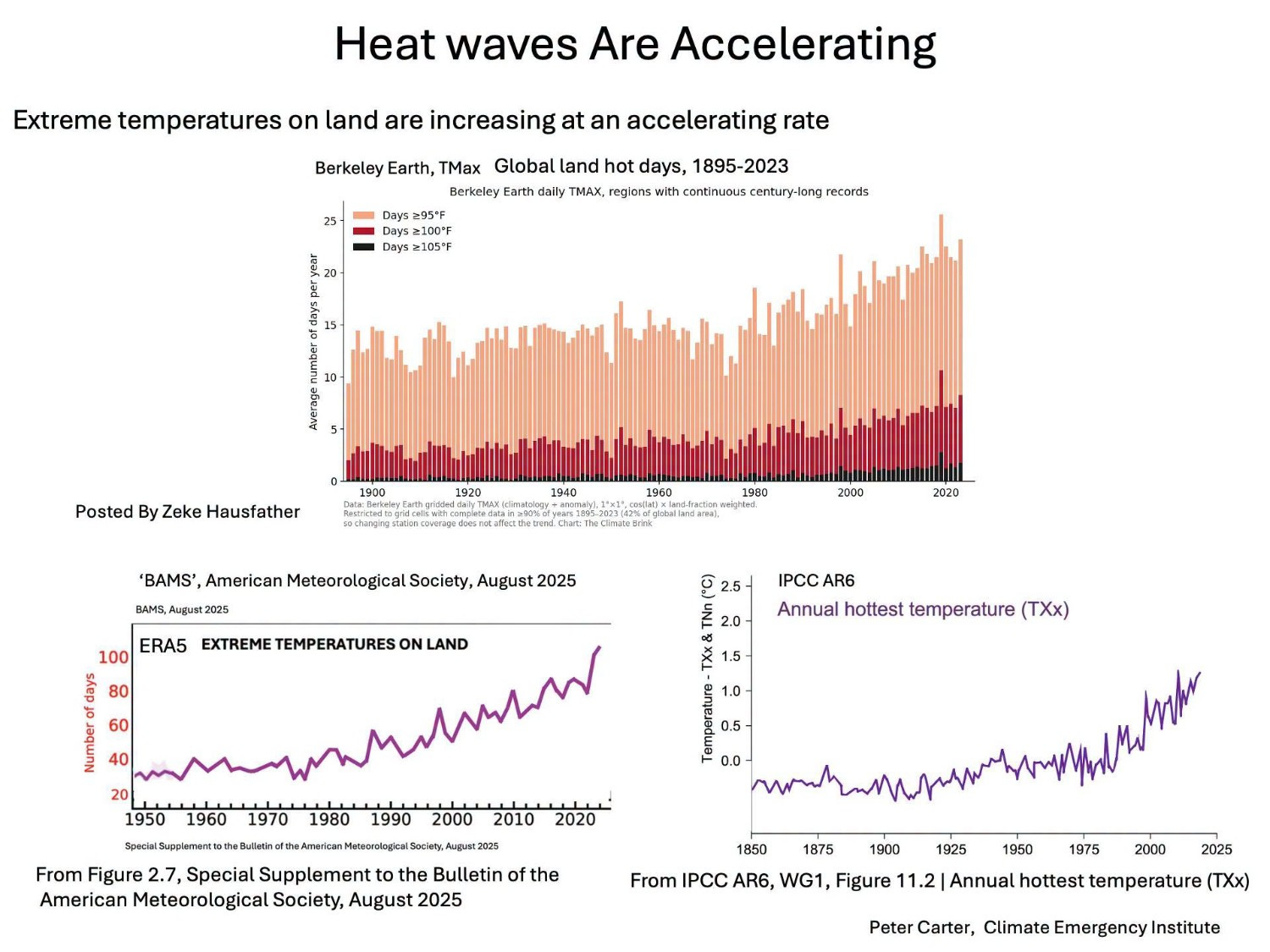
Heat waves Climate change makes extreme heat more frequent, them hotter, longer, and more widespread (Borenstein 2024; Rantanen 2024; Skinner 2025).
Heat Domes Climate change is increasingly stalling weather patterns and making long-lasting “heat domes” nearly three times more common today than in the 1950s (Li et. al 2025). A heat dome occurs when a persistent high-pressure weather system traps hot air over a region like a lid.
2026 State of Wildfires Report On 2024–2025 firesm Douglas I. Kelle et al, Climate change is increasing the frequency and intensity of extreme wildfires globally. Our attribution analyses show that climate change made extreme fire weather in Northeast Amazonia 30–70 times more likely, and fire weathter 3o times
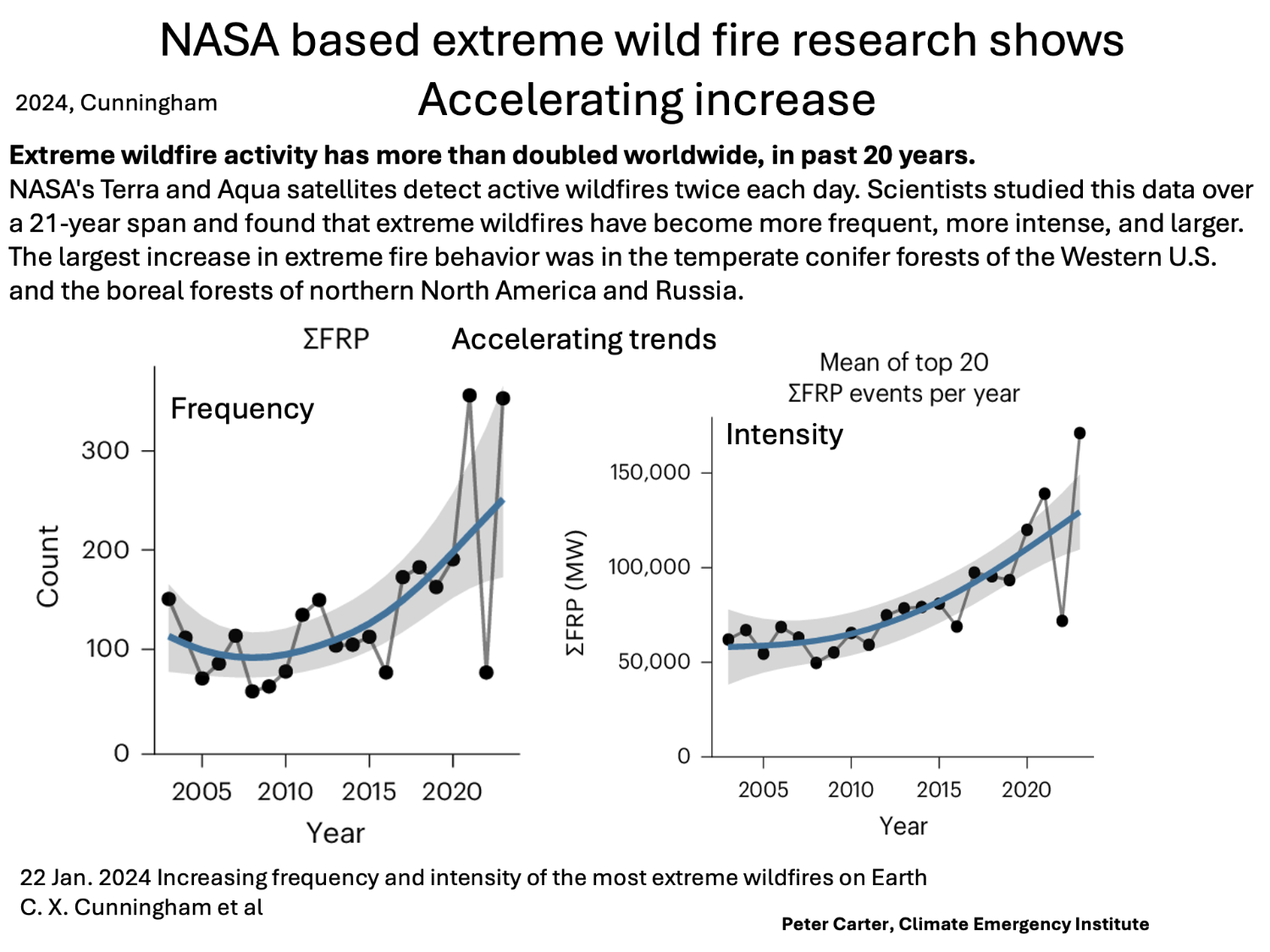
NASA's Terra and Aqua satellites detect active wildfires twice each day. Scientists studied this data over a 21-year span and found that extreme wildfires have become more frequent, more intense, and larger. The largest increase in extreme fire behavior was in the temperate conifer forests of the Western U.S. and the boreal forests of northern North America and Russia (NASA).
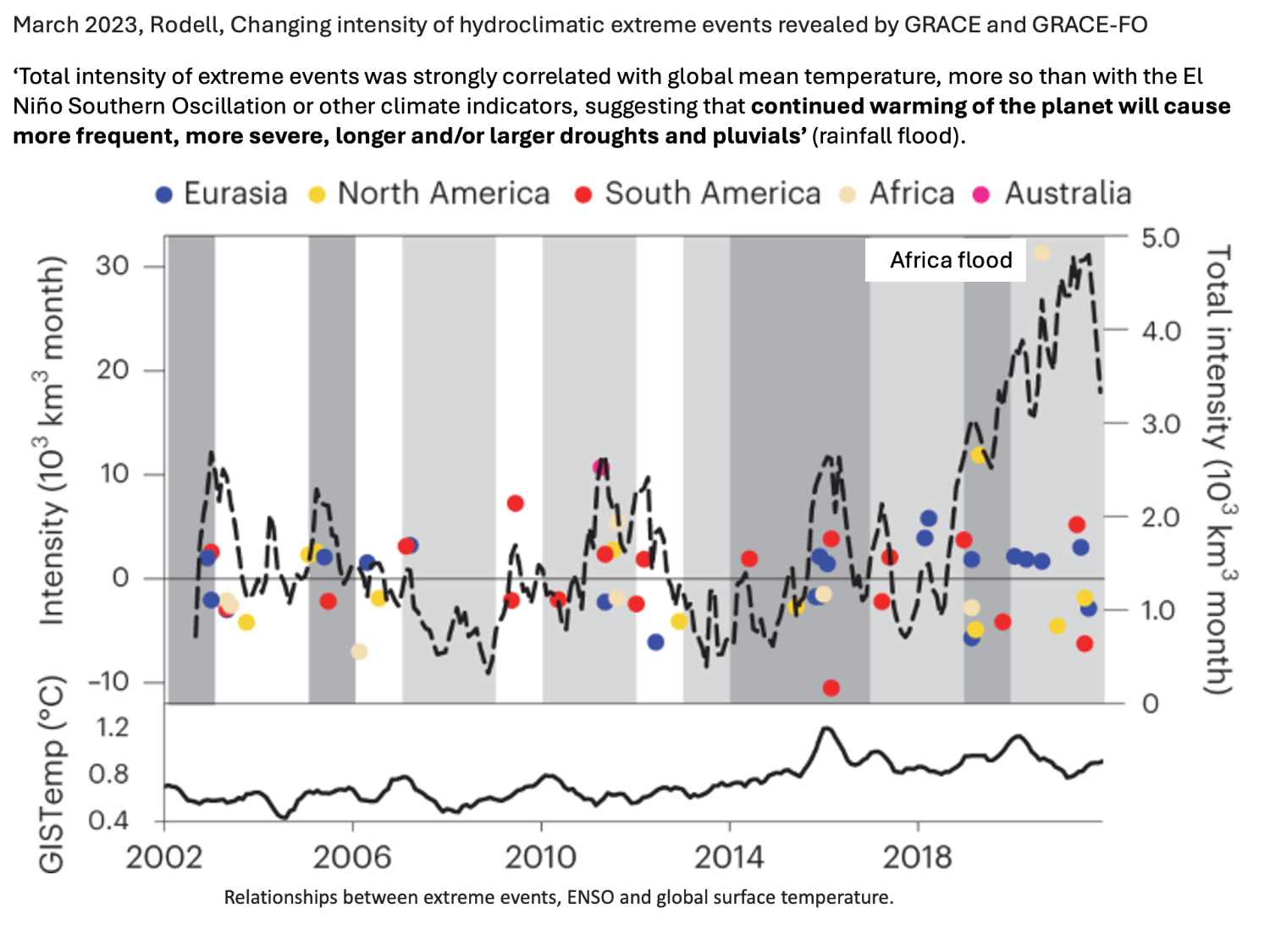
Drought and floods NASA,Warming Makes Droughts, Extreme Wet Events More Frequent, Intense In a study of 20 years of data from the NASA/German GRACE and GRACE-FO satellites it was found 'Total intensity of extreme events was strongly correlated with global mean temperature, more so than with the El Nino Southern Oscillation or other climate indicators, suggesting that continued warming of the planet will cause more frequent, more severe, longer, and/or larger droughts and pluvials.' Changing intensity of hydroclimatic extreme events revealed by GRACE and GRACE-FO
(NASA satellites) M. Rodell & B. Li
Heat waves
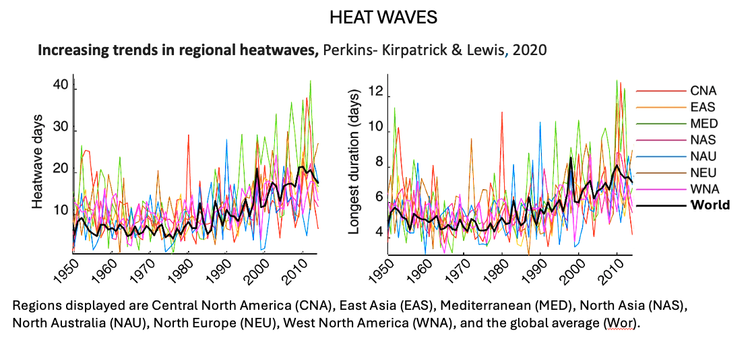
"Heatwaves have increased in intensity, frequency and duration, with these trends projected to worsen under enhanced global warming."
(July 2020, S. Perkins-Kirkpatrick & S. Lewis)
(July 2020, S. Perkins-Kirkpatrick & S. Lewis)
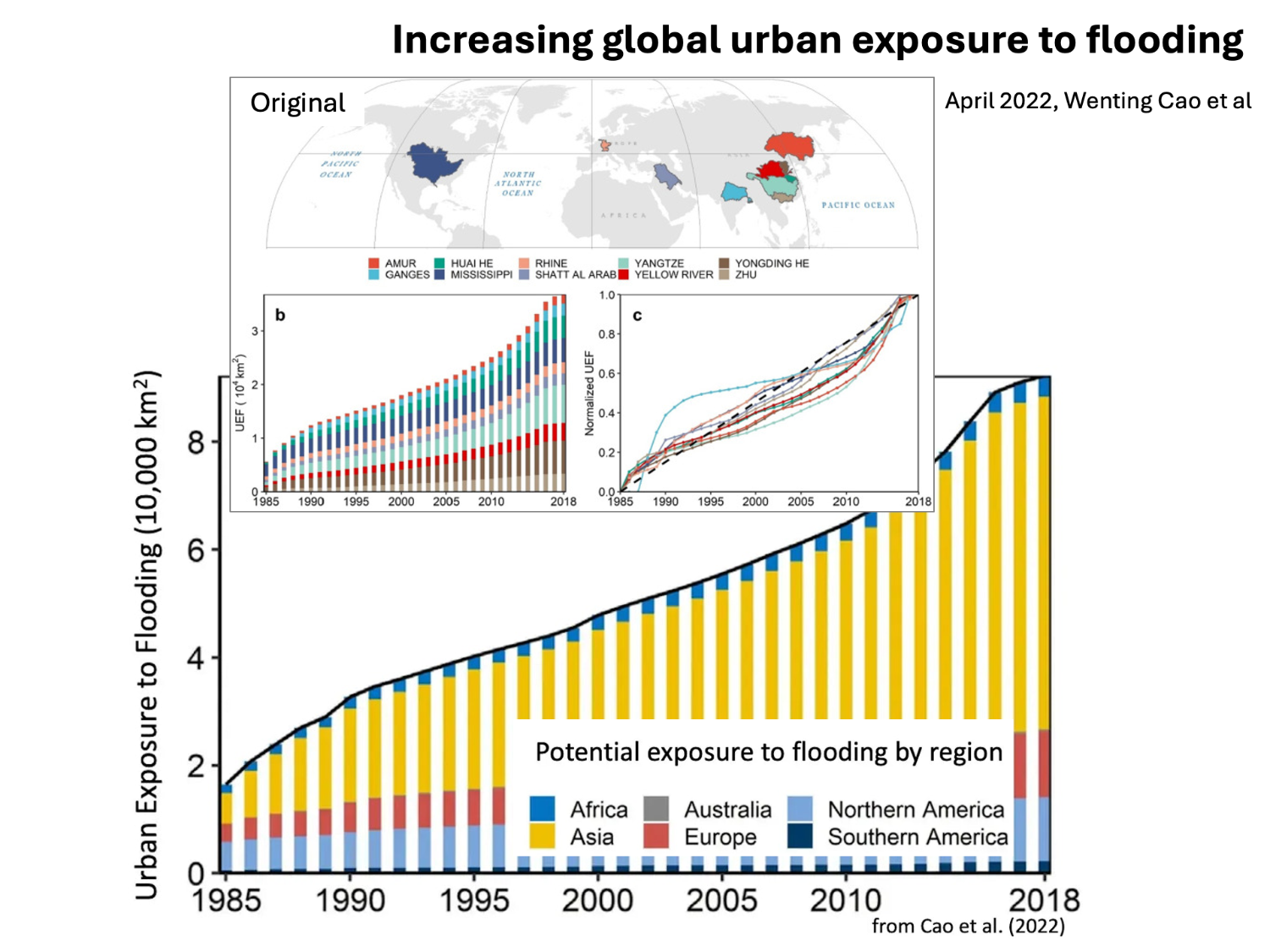
FLOODS Global Urban Exposure to Floods 'increased more than four-fold at an accelerated pace'. 'The most notable increase occurred in Eastern and Southeastern Asia'. (Increasing global urban exposure to flooding: An analysis of long-term annual dynamics, Wenting Cao et a, 2022)
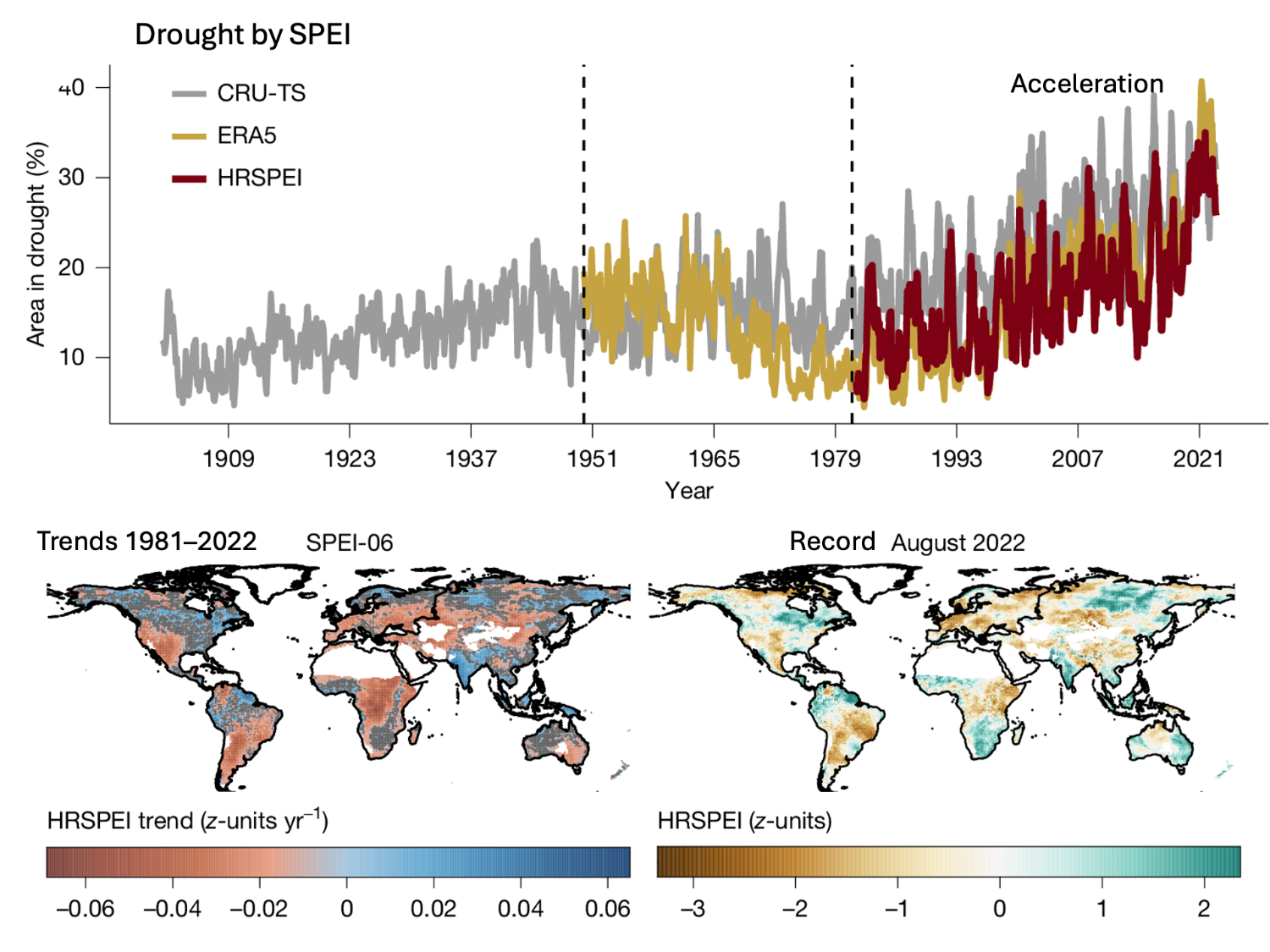
DROUGHT Warming accelerates global drought severity, S. Gebrechorkos et a, 4 June 2025
Not only are typically dry regions becoming drier but also wet areas are experiencing drying trends. During the past 5 years (2018–2022), the areas in drought have expanded by 74% compared with 1981–2017. The year 2022 was record-breaking, with 30% of the global land area affected by moderate and extreme droughts. Atmospheric evaporative demand from global warming impacts the recent evolution of the magnitude, frequency, duration and areal extent of droughts.
Not only are typically dry regions becoming drier but also wet areas are experiencing drying trends. During the past 5 years (2018–2022), the areas in drought have expanded by 74% compared with 1981–2017. The year 2022 was record-breaking, with 30% of the global land area affected by moderate and extreme droughts. Atmospheric evaporative demand from global warming impacts the recent evolution of the magnitude, frequency, duration and areal extent of droughts.
Acceleration According to the SPEI, over the past 42 years (1981–2022), global drought severity has intensified. In the past 5–10 years, this trend has accelerated as a consequence of the strong increase in AED, which is directly related to global warming.
2022, Rogers, 6-fold Increase in N. Hemisphere Concurrent Large Heatwaves Driven by Warming...
Scientists confirmed that major droughts and pluvials — periods of excessive precipitation and water storage on the landscape — have been occurring more often. They also found that the worldwide intensity of these extreme wet and dry events – a metric that combines extent, duration, and severity — is closely linked to global warming.
Warmer air causes more moisture to evaporate from Earth's surface during dry events; warm air hold more moisture to fuel severe rainfall.
Wild Fires Forest fires are increasing in size, severity, and intensity, across North America, Europe, and high-latitude boreal forests. (World Resources Institute)
WRI 2026 Interactive world Forest Fire Map, Updated WRI article, 4 Aug. 2026,
The Latest Data Confirms: Forest Fires Are Getting Worse Double canopy loss 20 yrs
14 March 2022, Alexandra Tyukavina, Global Trends of Forest Loss Due to Fire From 2001 to 2019. Univ. Maryland GLAD satellite project.
The Latest Data Confirms: Forest Fires Are Getting Worse Double canopy loss 20 yrs
14 March 2022, Alexandra Tyukavina, Global Trends of Forest Loss Due to Fire From 2001 to 2019. Univ. Maryland GLAD satellite project.
Increasing frequency and intensity of the most extreme wildfires, 24 June 2024, C. Cunningham
Increasing synchronicity of global extreme fire weather, Cong Yin et al, 18 Feb. 2026
All regions increase - with climatologically elevated SFW in boreal regions, as well as interregional synchronicity among northern temperate and boreal regions. Significant increases in SFW occurred during 1979 to 2024, with more than a twofold increase observed in most regions.
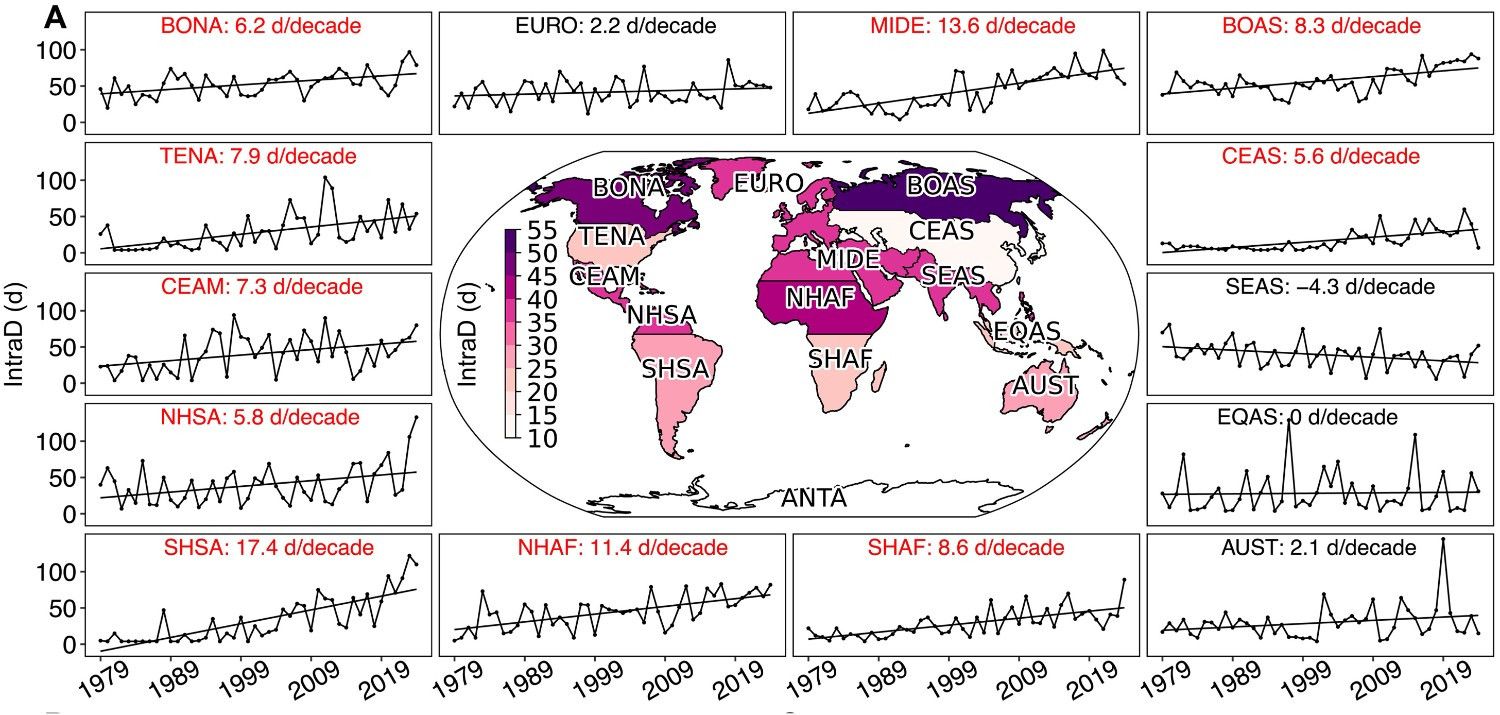
Changes in days with intraregional SFW
More extreme events in a warmer world
Wildfires are rapidly transforming parts of the Arctic once considered too cold and wet to burn extensively. From Alaska’s North Slope to the forests of Siberia and northern Canada, researchers are documenting a dramatic rise in fire activity (Arctic Portal 19 Feb 2026)