Climate Sensitivity
Climate Emergency Institute

July 2019 Most complete list.
Climate feedbacks in the Earth system and prospects for their evaluation

The IPCC has always used only a mean for its single fixed sensitivity
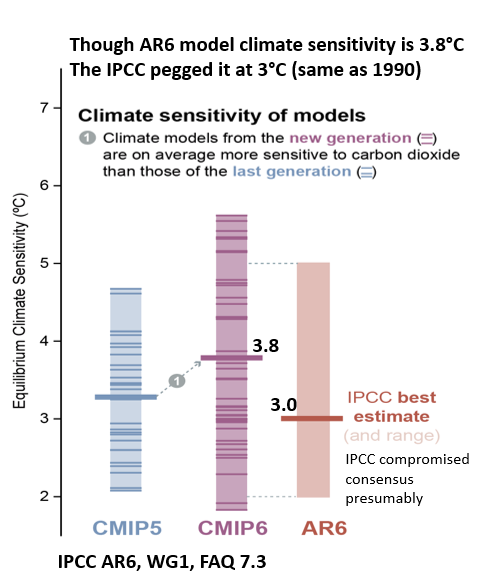
For the IPCC AR6 the IPCC rejected the latest model results that put the sensitivity higher, and downgraded it to 3°C again.
2021 IPCC AR6 sensitivity models result is 3.8°C,
but IPCC improperly pegged it back at 3°C (same as 1990), rejecting risk in the entire assessment.
For the IPCC AR6 the IPCC rejected the latest model results that put the sensitivity higher, and downgraded it to 3°C again.
2021 IPCC AR6 sensitivity models result is 3.8°C,
but IPCC improperly pegged it back at 3°C (same as 1990), rejecting risk in the entire assessment.
Double click here to edit this text.
IPCC AR6 climate sensitivity
Here is the big question for climate science .
If the climate change science, that policy makers rely on, turns about to be a large underestimate what happens to the future of the planet and of humanity?
The answer is runaway climate change (chaos) hot house Earth, because multiple enormous sources of amplifying are triggered. The big one is permafrost thaw, that is already releasing all three main GHGs -methane, CO2 and nitrous oxide. This is irreversible, and furthermore permafrost thaw become self-reinforcing. Thawing permafrost emits carbon by frozen microbes coming back to life and digesting organic material. This produces heat, which makes the thaw unstoppable and increasing.
The models that project the wide ranging sensitivity do not (still) include any any of these large feedbacks.
This the worst fundamental fatal flaw in climate change science- it's incredible.
The science has always agreed that higher climate sensitivity (than 3°C) is possible.
The 1st 1990 IPCC assessment put it at 3°C , a range up to 4.5°C
If it is, all the global warming impacts will be earlier and larger (we are already finding this) than projected at 3°C. That risk must be excluded using a higher sensitivity. This was explained by in 2009 by economist Martin Weitzman his paper On modeling and interpreting catastrophic climate change. Catastrophic impacts were mentioned in IPCC 2021 TAR and 2007 AR4, but not since. The IPCC in effect has excluded catastrophic climate change impacts.
In addition, the sensitivity will increase with temperature, because of the many amplifying feedback responses to warming. As the planet surface warms large feedbacks come into play. which are all positive (amplifying) the global temperature increase. We already have methane and nitrous oxide that will increase with further warming, making the climate more sensitive. The IPCC excludes these from the projections by not adding extra feedback warming to climate sensitivity based on its warming projections. We know these feedbacks will happen and indeed they have started, but the IPCC acts as if they don't exist.
If the climate change science, that policy makers rely on, turns about to be a large underestimate what happens to the future of the planet and of humanity?
The answer is runaway climate change (chaos) hot house Earth, because multiple enormous sources of amplifying are triggered. The big one is permafrost thaw, that is already releasing all three main GHGs -methane, CO2 and nitrous oxide. This is irreversible, and furthermore permafrost thaw become self-reinforcing. Thawing permafrost emits carbon by frozen microbes coming back to life and digesting organic material. This produces heat, which makes the thaw unstoppable and increasing.
The models that project the wide ranging sensitivity do not (still) include any any of these large feedbacks.
This the worst fundamental fatal flaw in climate change science- it's incredible.
The science has always agreed that higher climate sensitivity (than 3°C) is possible.
The 1st 1990 IPCC assessment put it at 3°C , a range up to 4.5°C
If it is, all the global warming impacts will be earlier and larger (we are already finding this) than projected at 3°C. That risk must be excluded using a higher sensitivity. This was explained by in 2009 by economist Martin Weitzman his paper On modeling and interpreting catastrophic climate change. Catastrophic impacts were mentioned in IPCC 2021 TAR and 2007 AR4, but not since. The IPCC in effect has excluded catastrophic climate change impacts.
In addition, the sensitivity will increase with temperature, because of the many amplifying feedback responses to warming. As the planet surface warms large feedbacks come into play. which are all positive (amplifying) the global temperature increase. We already have methane and nitrous oxide that will increase with further warming, making the climate more sensitive. The IPCC excludes these from the projections by not adding extra feedback warming to climate sensitivity based on its warming projections. We know these feedbacks will happen and indeed they have started, but the IPCC acts as if they don't exist.

Climate sensitivity is the fundamental metric determining all projections in climate change science. It is a single fixed metric, but it is bound to increase with global temperature due to inevitable amplifying feedbacks.
It is defined as the equilibrium warming resulting from a doubling of atmospheric CO2.
James Hansen (et al) puts it at 4.5°C, not 3°C.
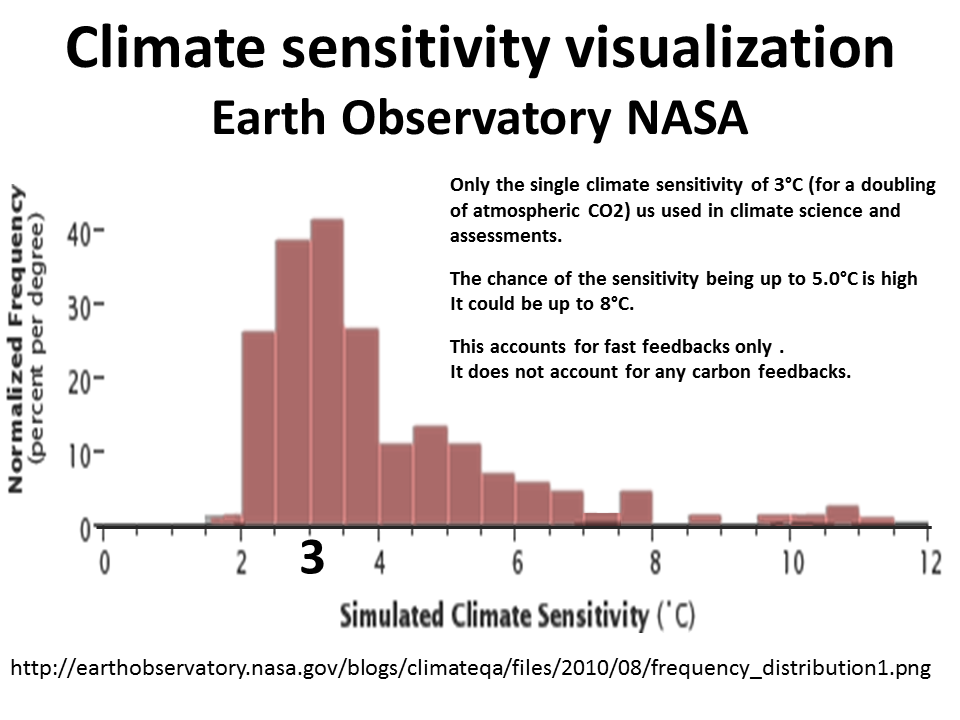
There has always been a very large range from the models used.
The IPCC just takes (only) the middle of the range. It has been 3°C since the fits 1990 IPCC Assessment. The IPCC 6th Assessment kept it at 3°C, even though the models had 3.8°C.
The science uses this one fixed number for climate sensitivity, 3 °C
It is defined as the equilibrium warming resulting from a doubling of atmospheric CO2.
James Hansen (et al) puts it at 4.5°C, not 3°C.
There has always been a very large range from the models used.
The IPCC just takes (only) the middle of the range. It has been 3°C since the fits 1990 IPCC Assessment. The IPCC 6th Assessment kept it at 3°C, even though the models had 3.8°C.
The science uses this one fixed number for climate sensitivity, 3 °C
It does not account for amplifying global warming feedbacks, inevitable as surface temperatures rise, nor
weakening of the carbon sinks, long known to be inevitable with rising temperatures.
Video 2011, AGU panel presentation
Paleoclimate record points toward potential rapid climate change
There is no one number that is climate sensitivity
Paleoclimate record points toward potential rapid climate change
There is no one number that is climate sensitivity
IPCC AR6 Climate Sensitivity
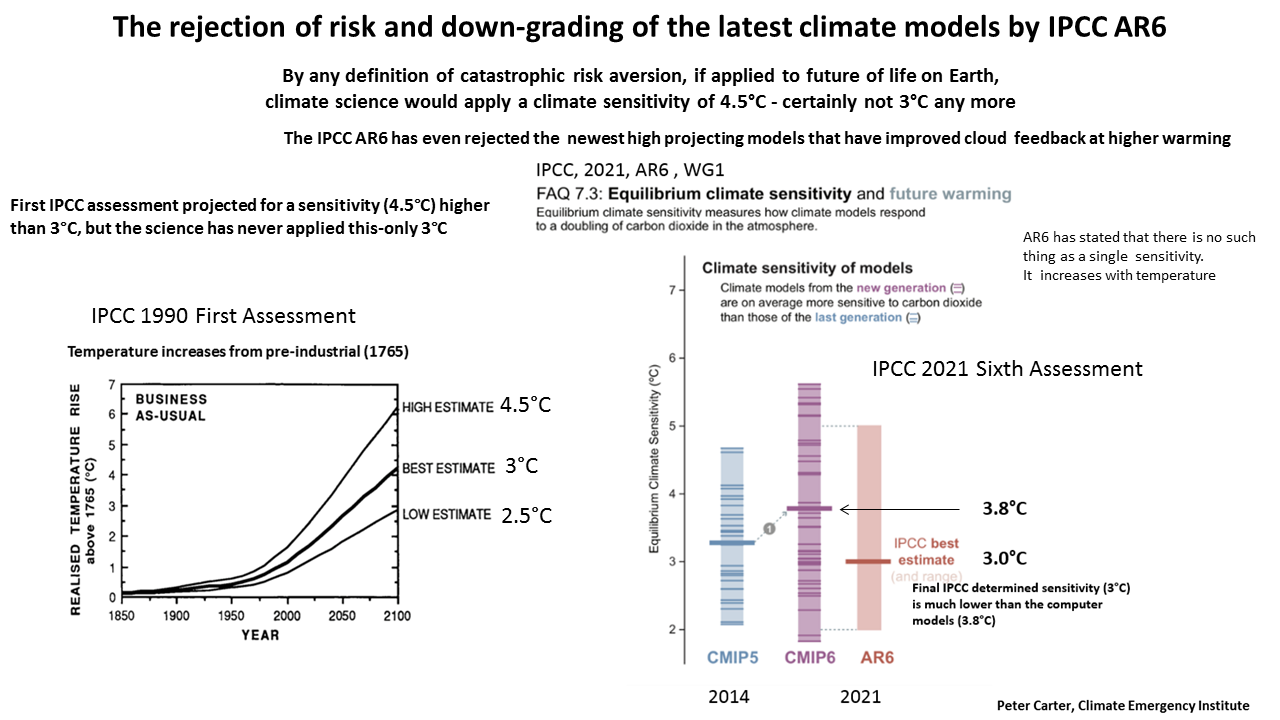
This one number determines all the science projections for the future, and it will not stay the same- it will increase with warming by degree and time.
This excludes risk from the entire IPCC Assessments.
This excludes risk from the entire IPCC Assessments.
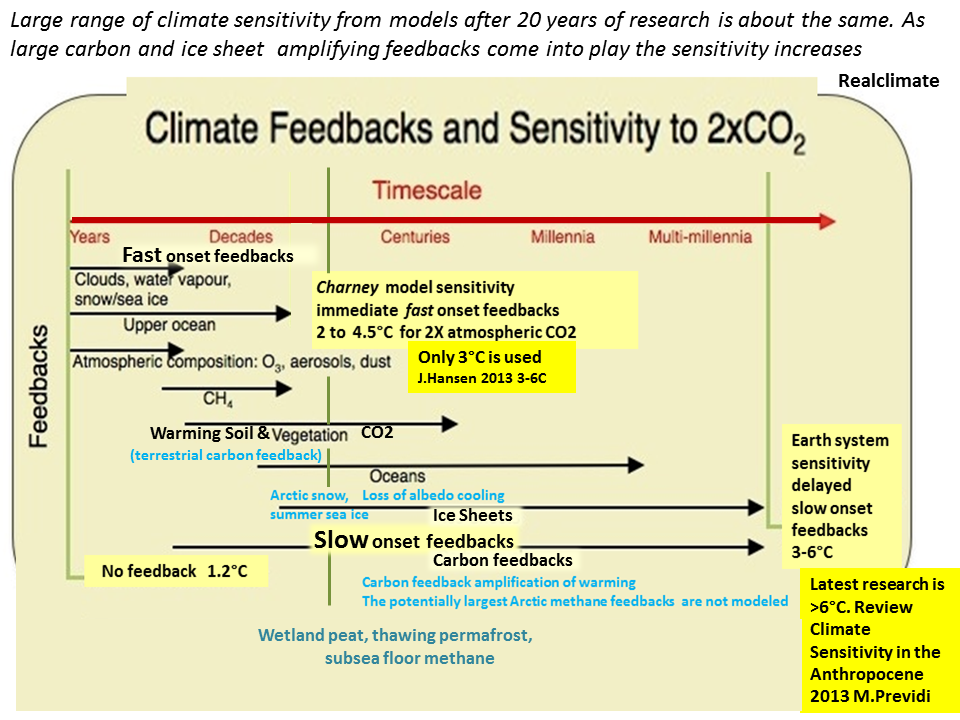
There are in fact two climate sensitivities- fast and slow.
The slow feedback accounts for future large sources of increased sensitivity, like feedback emissions from permafrost thaw and loss of ice
Fast (onset) and slow (onset) feedback sensitivity.
Range of uncertainty
Finally, there are wide ranges of uncertainty for all aspects of climate change modeling (IPCC 2007), and there is a wide range of uncertainty for the fast climate sensitivity that determines the entire assessment of climate chang
The slow feedback accounts for future large sources of increased sensitivity, like feedback emissions from permafrost thaw and loss of ice
Fast (onset) and slow (onset) feedback sensitivity.
The fast onset feedbacks are the ones that immediately act in response to an increase in atmospheric greenhouse gases (GHGs). They are mainly atmospheric feedbacks in the air, like water vapor, clouds and minute suspended particles (aerosols). Some albedo cooling effect of snow and ice is included.
Water vapor is actually the main GHG because it is so abundant but its global warming effect is mainly a feedback response. Warm air holds more water vapor and that about doubles the warming caused just by a GHG increase.
Slow onset feedbacks are planetary responses to global warming like melting ice sheets and thawing permafrost. Warming wetland peat is a slow feedbacks and melting sub seafloor methane hydrate is considered a very slow feedback.
The fast feedback CS is taken to be 3°C by the scientists and the slow feedback sensitivity is not used in the assessments- a huge error in underestimating the actual warming that will occur over the long term future.
It was James Hansen who pointed out in a 2008 paper that the true climate sensitivity for the very long term is (6C), which is double the immediate fast feedback sensitivity (3C) that has been applied by the science since the first IPCC assessment in 1990.
It is the 'true' CS because it is protective of all future generations and life. The fast CS that does not include the large slow feedbacks is not protective. The slow FS is therefore by far the most policy relevant.
Slow feedbacks take a long time (hence 'slow') in response to global warming, but they greatly increase over time and are irreversible. They include loss of albedo cooling from ice melting and Arctic carbon feedbacks from warming wetlands and thawing permafrost, that release methane and carbon dioxide
The metric is fixed to allow for climate change modeling. However in the real world the climate sensitivity is dynamic - with warming it increases as does the risk of abrupt warming.
Range of uncertainty
Finally, there are wide ranges of uncertainty for all aspects of climate change modeling (IPCC 2007), and there is a wide range of uncertainty for the fast climate sensitivity that determines the entire assessment of climate chang
"... climate sensitivity only considers the surface mean temperature and gives no indication of the occurrence of abrupt changes or extreme events. Despite its limitations, however, the climate sensitivity remains a useful concept.. IPCC AR4 2007 8.6.2.1 Definition of Climate Sensitivity"
The fact is climate sensitivity is not a linear constant factor (as is the case in the science), it is dynamic increasing with time and temperature of warming. This is because of the many positive (bad) feedbacks that increase with warming and decline of carbon sinks due to climate change effects.