Black carbon soot
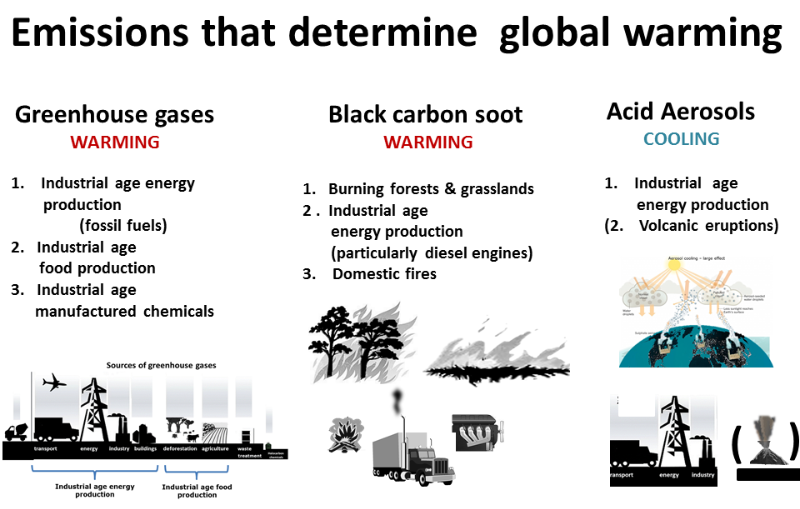
Black carbon causing warming in two ways. Being black soot is a good heat absorber in the atmosphere and also on snow where it reduces the albedo cooling effect.
Acid aerosol cooling emissions
Also we must remember the the warming from greenhouse emissions is off set by acid aerosol cooling emissions, from volcanic eruptions transiently and fossil fuel air pollution constantly.
Black carbon causing warming in two ways. Being black soot is a good heat absorber in the atmosphere and also on snow where it reduces the albedo cooling effect.
Acid aerosol cooling emissions
Also we must remember the the warming from greenhouse emissions is off set by acid aerosol cooling emissions, from volcanic eruptions transiently and fossil fuel air pollution constantly.
Emissions
Fossil fuels
Industrial energy production is the main source of GHG emissions, with still over 80% of world energy from burning fossil fuels, and there are no plans to change this.
Fossil fuel toxic air pollution emissions disable and kill a huge number of people through toxic air pollution (8-10 million killed per year). Most of the chronic disorders of the industrialized world have a fossil factor causing them.
FOSSIL FUEL GREENHOUSE EMISSIONS
Carbon dioxide Fossil fuels are the major source of CO2 emissions
and coal has always been the worst for toxic
air pollution and GHG emissions
(including CO2 ocean acidification).
Most countries still subsidize coal.
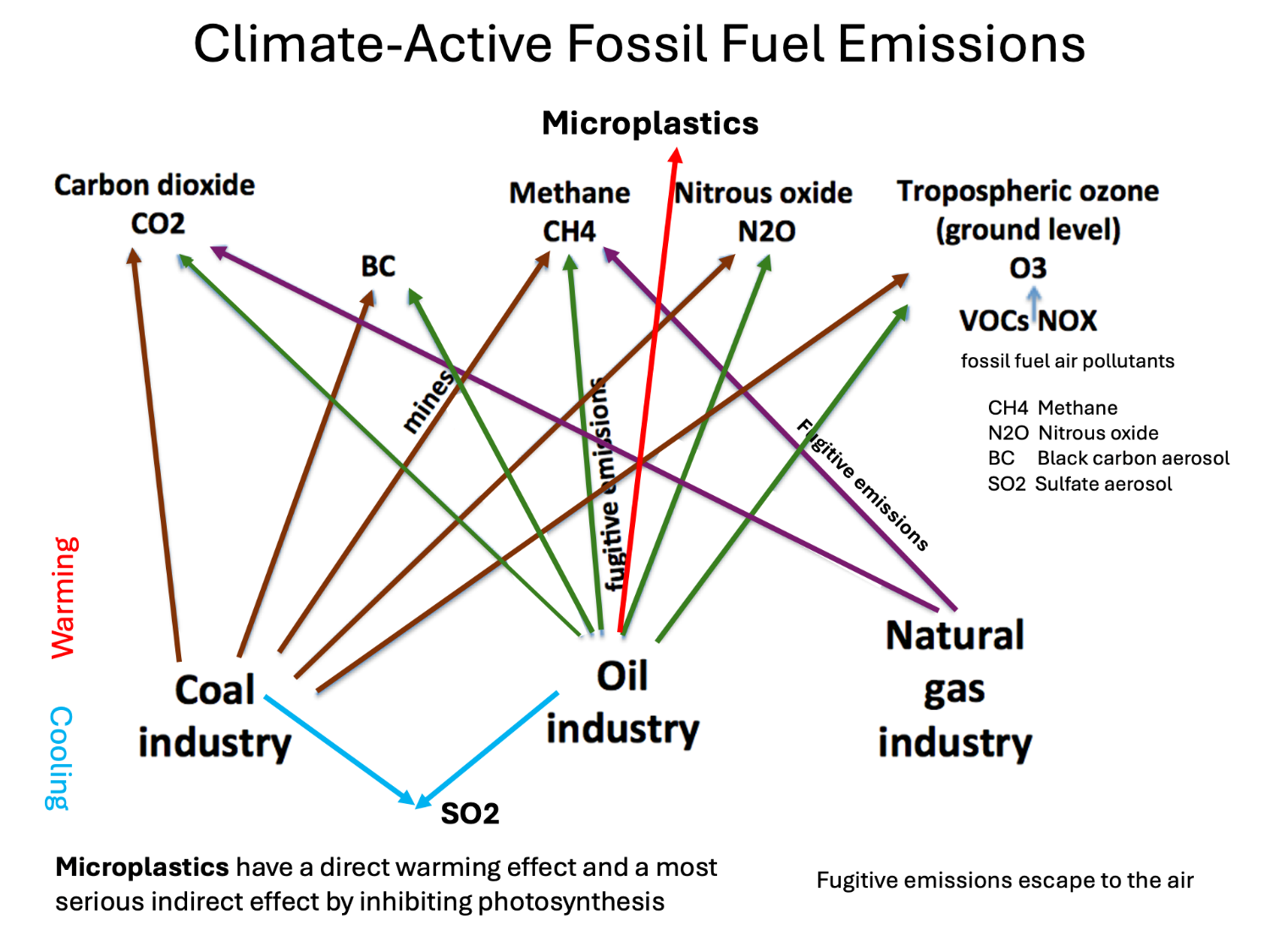
Methane is emitted by fossil fuels.
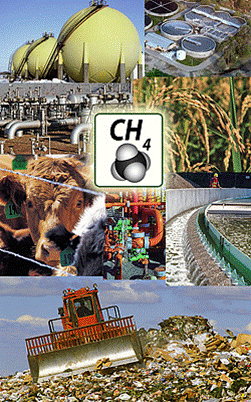
Methane is emitted as fugitive (leaks) emissions from natural gas distribution (gas is mainly methane) and from coal mining, and (research June 2014) also abandoned oil wells.
Tropospheric (ground level) ozone is a GHGas, formed by a chemical reaction between air pollutants emitted by fossil fuels catalyzed by ambient warmth of the sun.
Fossil fuels are a source of BC Black Carbon (soot) mainly from diesel engines.
Ethane Propane and Butane
These GHGs are all fugative emissions from the natural gas industry, especially now with fracking. Ethane is also involved in the chemical reaction producing ground ozone in the air (a GHG).
Acid Aerosols. Fossil fuels are the main source of air pollution cooling aerosols, but that is also a very bad thing. The fossil fuel air pollution cooling masks a lot of the CO2 warming. This deferred heat will be unmasked by countries having to clean up their air pollution and because the world has to stop burning fossil fuels - the zero carbon combustion imperative for stabilization.
Committed future warming Fossil fuel pollution as well as heating the planet today, is storing up much more heat that will hit us hard in the future and last practically for ever.
Zero carbon combustion emissions
The science is definite that to stabilize global temperature and ocean acidification we must stop industrial carbon emissions. Net zero has to be zero fossil fuel energy.
Industrial energy production is the main source of GHG emissions, with still over 80% of world energy from burning fossil fuels, and there are no plans to change this.
The source of energy that made for the easy labor saving affluent lives of many, is now ruining life in the future for us all through the constant emission of very last lasting GHGs (mainly CO2) into the atmosphere.
The source of energy that made for the easy labor saving affluent lives of many, is now ruining life in the future for us all through the constant emission of very last lasting GHGs (mainly CO2) into the atmosphere.
Fossil fuel toxic air pollution emissions disable and kill a huge number of people through toxic air pollution (8-10 million killed per year). Most of the chronic disorders of the industrialized world have a fossil factor causing them.
FOSSIL FUEL GREENHOUSE EMISSIONS
Carbon dioxide Fossil fuels are the major source of CO2 emissions
and coal has always been the worst for toxic
air pollution and GHG emissions
(including CO2 ocean acidification).
Most countries still subsidize coal.
Methane is emitted by fossil fuels.
Methane is emitted as fugitive (leaks) emissions from natural gas distribution (gas is mainly methane) and from coal mining, and (research June 2014) also abandoned oil wells.
Tropospheric (ground level) ozone is a GHGas, formed by a chemical reaction between air pollutants emitted by fossil fuels catalyzed by ambient warmth of the sun.
Fossil fuels are a source of BC Black Carbon (soot) mainly from diesel engines.
Ethane Propane and Butane
These GHGs are all fugative emissions from the natural gas industry, especially now with fracking. Ethane is also involved in the chemical reaction producing ground ozone in the air (a GHG).
Acid Aerosols. Fossil fuels are the main source of air pollution cooling aerosols, but that is also a very bad thing. The fossil fuel air pollution cooling masks a lot of the CO2 warming. This deferred heat will be unmasked by countries having to clean up their air pollution and because the world has to stop burning fossil fuels - the zero carbon combustion imperative for stabilization.
Committed future warming Fossil fuel pollution as well as heating the planet today, is storing up much more heat that will hit us hard in the future and last practically for ever.
Zero carbon combustion emissions
The science is definite that to stabilize global temperature and ocean acidification we must stop industrial carbon emissions. Net zero has to be zero fossil fuel energy.
Instead of heading towards zero CO2 emissions,
they are being increased as fast as ever.
they are being increased as fast as ever.
CO2 equivalent emissions
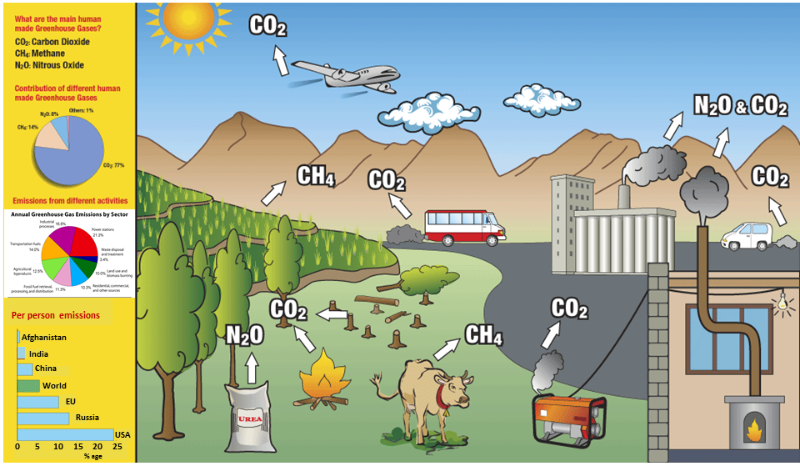
It is most important for mitigation that emissions are by CO2 equivalent (as IPCC and UNEP do) rather by CO2 only. CO2 equivalent includes methane and nitrous oxide, calculated as the equivalent amount of CO2.
It is most important for mitigation that emissions are by CO2 equivalent (as IPCC and UNEP do) rather by CO2 only. CO2 equivalent includes methane and nitrous oxide, calculated as the equivalent amount of CO2.
FOOD PRODUCTION (Industrial scale)
If fully estimated global emissions may not be far off industrial energy production in emitting GHGs.
It is estimated at 30% of GHG emissions, but if methane warming is not future discounted it would be closer to 50%.
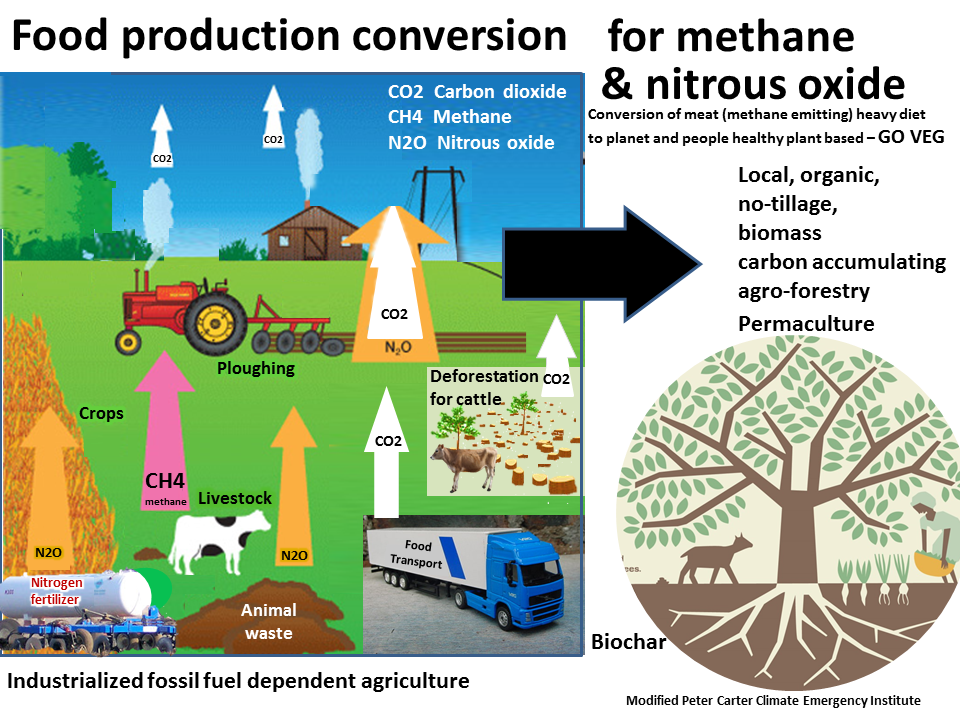
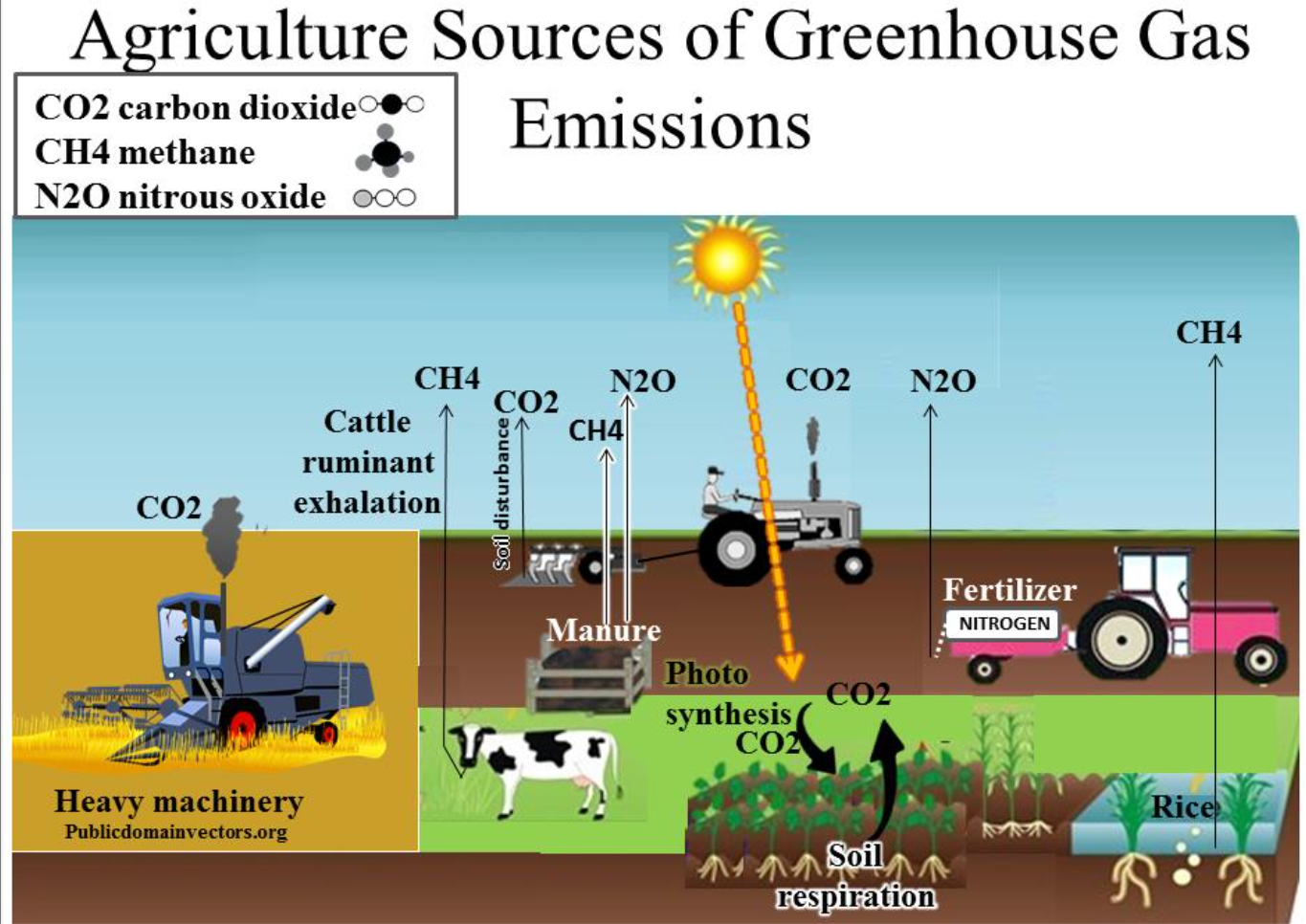
Methane: main source of food production emissions is livestock
(ruminants exhale methane from digesting grasses)
The industrial age diet is meat heavy- bad for people and the planet.
Wetland rice cultivation is a source of mehane
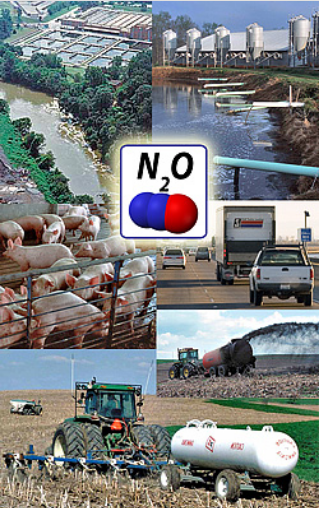
Nitrous oxide: main source is large scale agriculture that depends on large amounts of chemical nitrogen fertilizer, which is made from natural gas.
Another food production source is livestock waste.
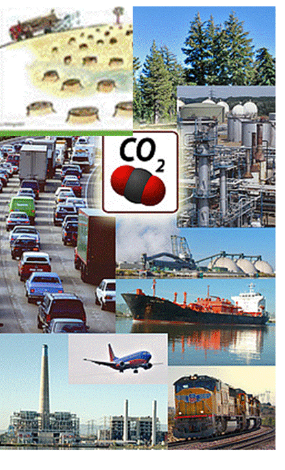
CO2 Fossil fuel energy is used by industrial food production due to long food transportation and refrigeration.
Deforestation (mainly for agriculture) is a large source of CO2 emissions, because clearing of forests allows the carbon on and in the forest floor to be emitted, and there is no forest left to re-absorb the carbon.
If fully estimated global emissions may not be far off industrial energy production in emitting GHGs.
It is estimated at 30% of GHG emissions, but if methane warming is not future discounted it would be closer to 50%.
Methane: main source of food production emissions is livestock
(ruminants exhale methane from digesting grasses)
The industrial age diet is meat heavy- bad for people and the planet.
Wetland rice cultivation is a source of mehane
Nitrous oxide: main source is large scale agriculture that depends on large amounts of chemical nitrogen fertilizer, which is made from natural gas.
Another food production source is livestock waste.
CO2 Fossil fuel energy is used by industrial food production due to long food transportation and refrigeration.
Deforestation (mainly for agriculture) is a large source of CO2 emissions, because clearing of forests allows the carbon on and in the forest floor to be emitted, and there is no forest left to re-absorb the carbon.
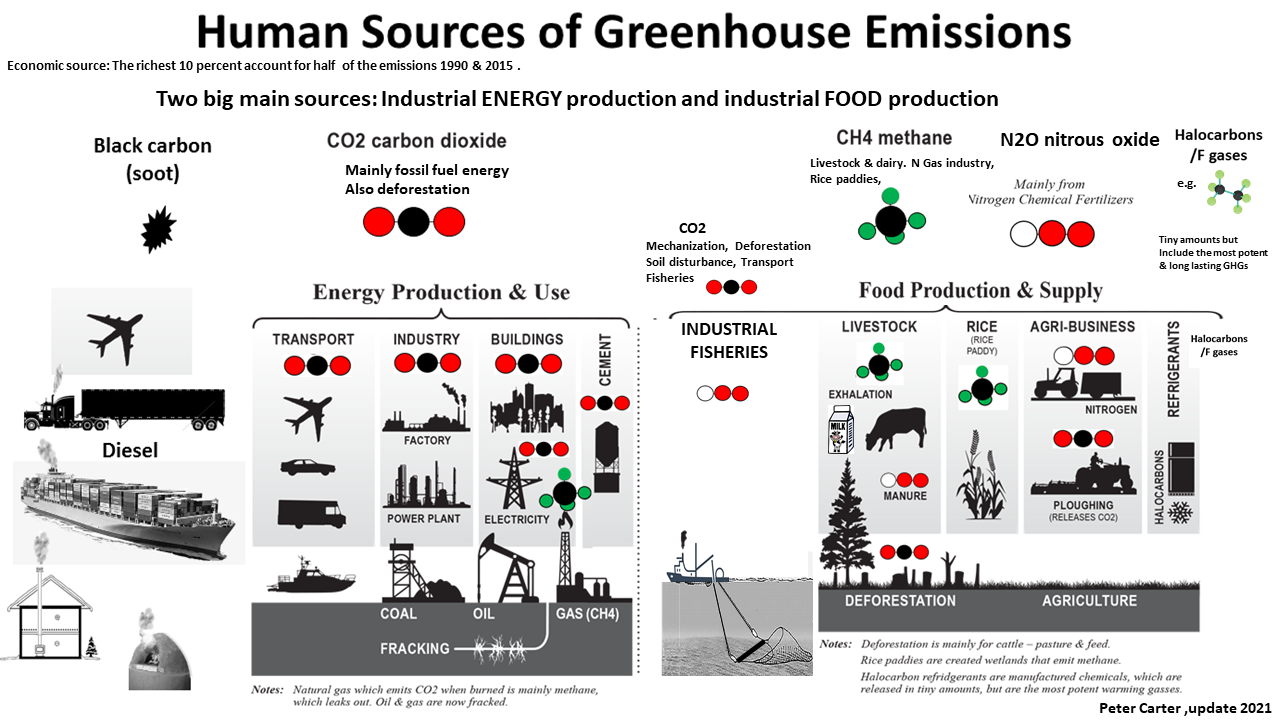
A simple way to look at GHG emissions is
from two big main sources-
1. industrial energy production/use and
2. industrial food production/use
from two big main sources-
1. industrial energy production/use and
2. industrial food production/use
Fossil fuel air pollution It's causing 8 million deaths/year Jan 2021

Fossil fuels emit
o CO2: Carbon dioxide (heating and ocean acidification )
o CH4: Methane. (warming, precursor gas in the formation of surface ozone)
o N2O: Nitrous oxide. (warming, now top stratospheric ozone depleter)
o BC Black carbon soot aerosol (air pollutant): warming
o SO4 (sulfate) acid aerosol (air pollutant, acid rain): Cooling
o Surface Ozone, as well is a toxic air pollutant, is a greenhouse gas that is formed by chemical reaction of fossil fuel air pollutants, catalyzed by ambient heat, so increased by global warming,
o Particulate toxic air pollution
o Microplastic (MP) air and water pollution Ubiquitous, Colored MP are global warming,
aslo inhibit photosynthesis, so reduce land and water carbon sinks
o Microplastic (MP) air and water pollution Ubiquitous, Colored MP are global warming,
aslo inhibit photosynthesis, so reduce land and water carbon sinks
Double click here to edit this text.
CO2 is and ultra-long lasting GHG in the atmosphere - about 200 years but 20% lasts 1000 years.
Climate change mitigation therefore requires elimination of our CO2 emissions
which means ZERO FOSSIL FUEL COMBUSTION
No fossil fuels, and no wood/biomass
Climate change mitigation therefore requires elimination of our CO2 emissions
which means ZERO FOSSIL FUEL COMBUSTION
No fossil fuels, and no wood/biomass
Climate Emergency Institute

CO2 is the top global heating emission, which is increasing (being increased)
It is causing most of the global heating and all the ocean acidification
It is causing most of the global heating and all the ocean acidification
3 Jun2 2024, History of CO2 emissions World Resources Institute
Also Military Emissions
The world military is a huge emitter estimated at 5-6% of global emissions
but not accounted for in assessments or policy.This skyrockets with actual wars.
The world military is a huge emitter estimated at 5-6% of global emissions
but not accounted for in assessments or policy.This skyrockets with actual wars.
Climate Active Emissions
> CO2: Carbon dioxide (heating, ocean acidification)
> CH4: Methane
> N2O: Nitrous oxide,
> BC :Black carbon soot aerosol: warming
> SO4 Sulfate acid aerosol cooling
> Surface Ozone (O3): short-lived greenhouse gas (formed from fossil fuel air pollutants)
> F-gases/halocarbons synthetic (man–made) include the most potent and most long-lived GHGs
EDGAR 2025, GHG emissions of all world countries
2025 report. EDGAR Emissions Database for Global Atmospheric Research
Methane
Nitrous oxide
China, the United States, India, the EU27, Russia and Indonesia were the world's largest GHG emitters in 2024.
Together they account for 51.4% of global population, 62.5% of global gross domestic product, 64.2% of global fossil fuel consumption and 61.8% of global GHG emissions.
Together they account for 51.4% of global population, 62.5% of global gross domestic product, 64.2% of global fossil fuel consumption and 61.8% of global GHG emissions.
EDGAR 2025 Emissions Database Global Atmospheric Research
EDGAR is the primary source for world GHG emissions
EDGAR is the primary source for world GHG emissions
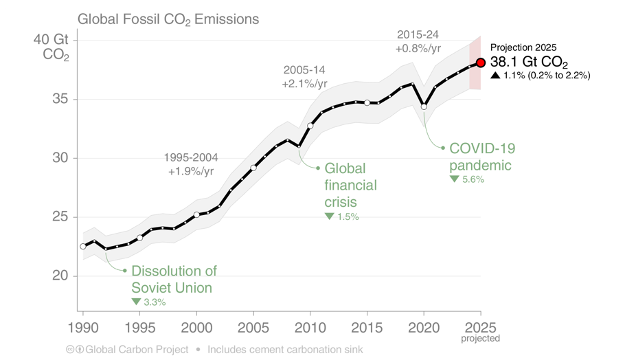
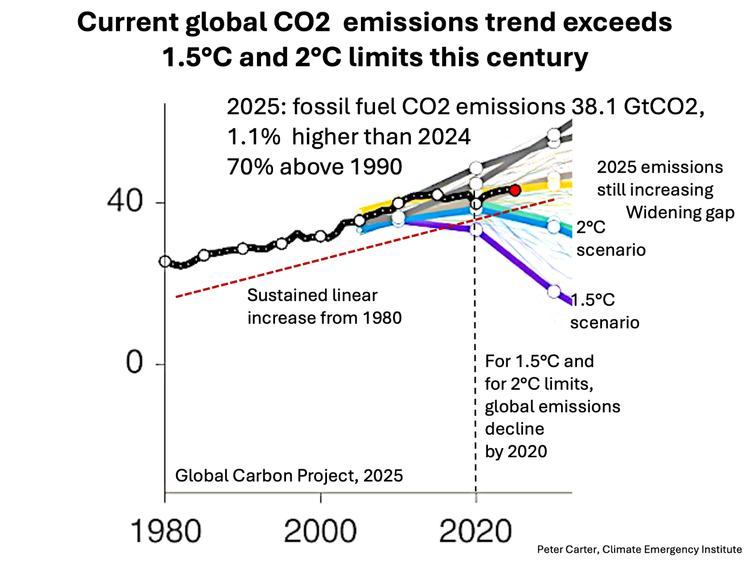
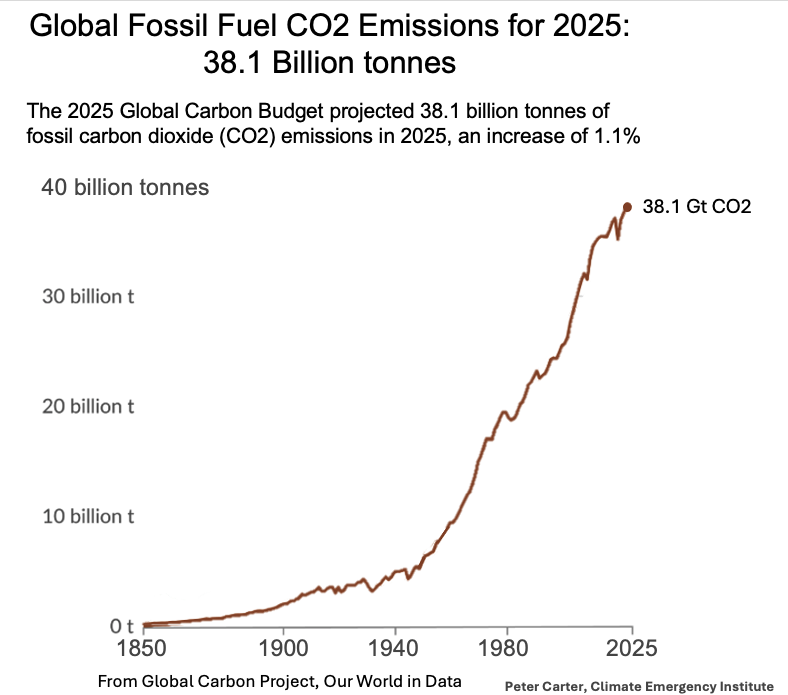
2025 Global Carbon Project fossil fuel CO2 emissions increased 1.1% to 38.1 Gt CO2
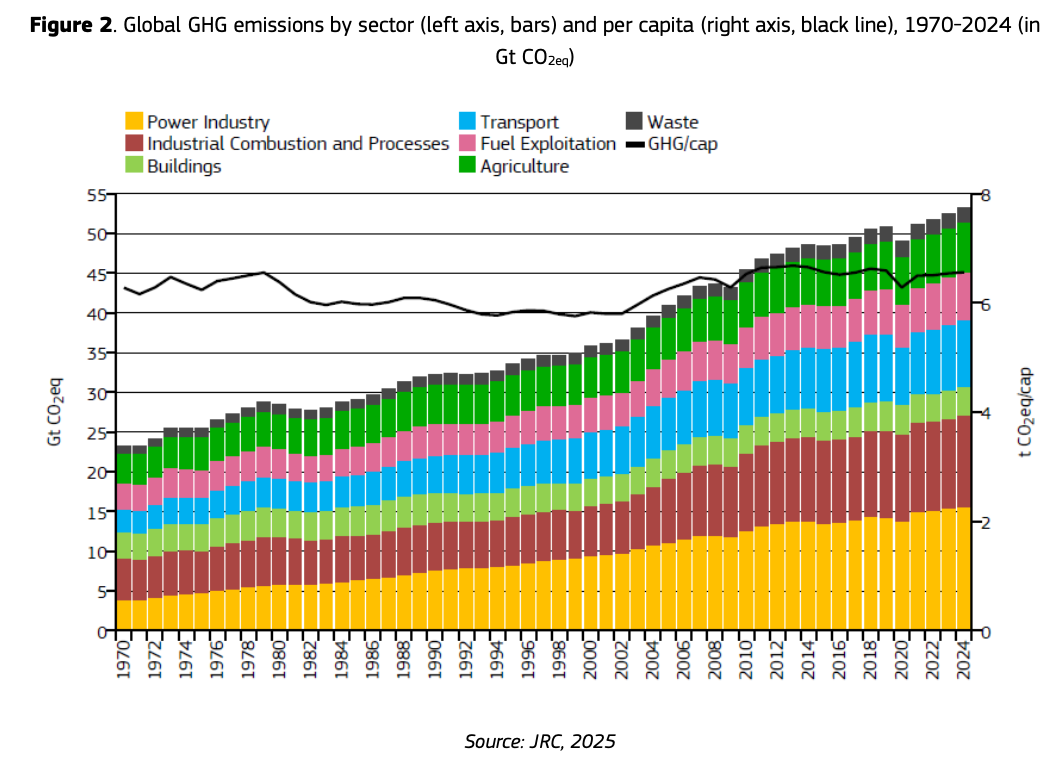
2025 EDGAR, 2024 global GHG emissions increased 1.3% from 2023, 53.2 GtCO2 eq.
2025 EDGAR, 2024 global GHG emissions increased 1.3% from 2023, 53.2 GtCO2 eq.
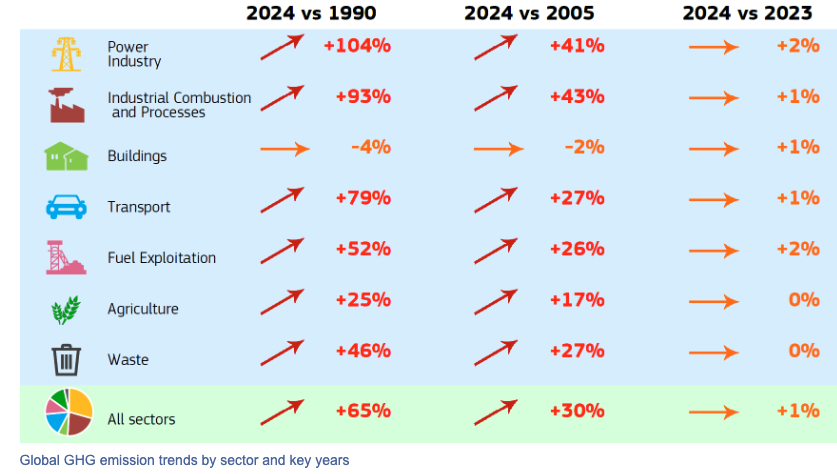
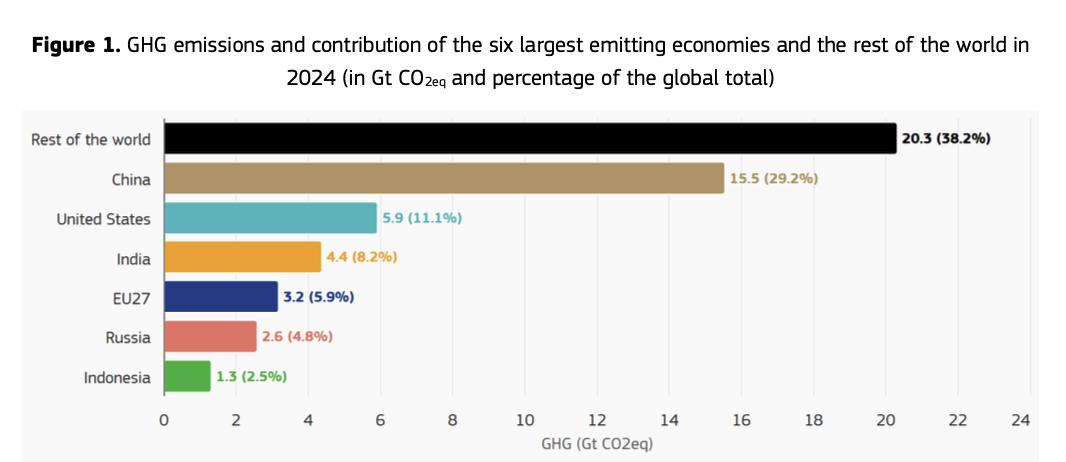
Source of greenhouse gas (GHG) emissions is EDGAR
Source of fossil fuel CO2 emissions Is Global Carbon Project
Source of fossil fuel CO2 emissions Is Global Carbon Project
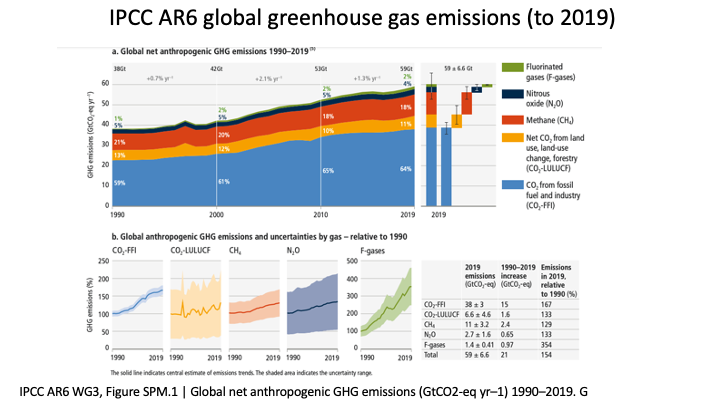
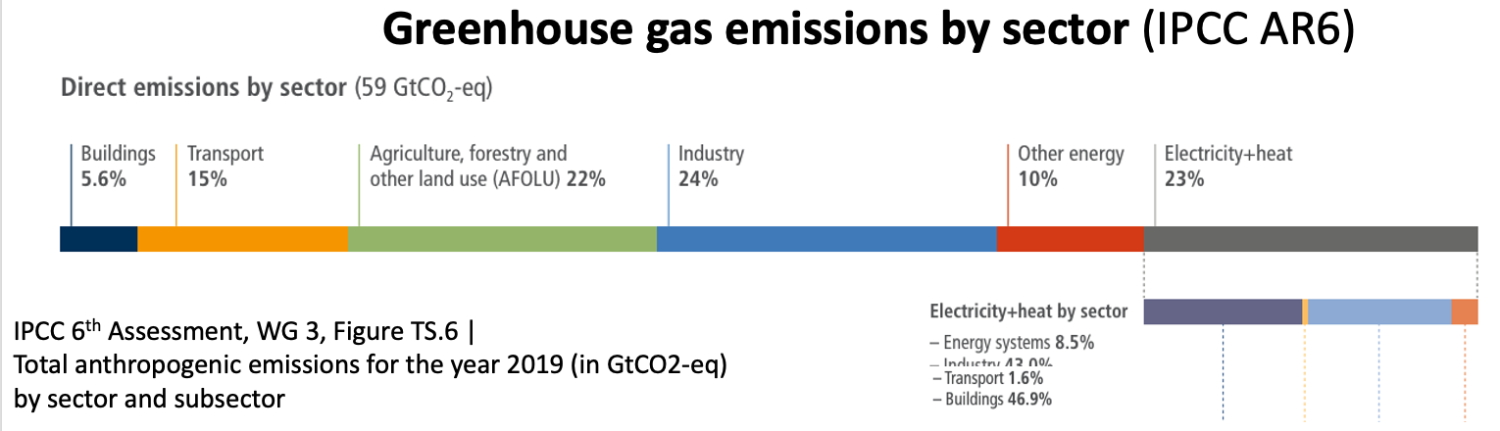
IPCC AR6
GHG emissions are measured as CO2 equivalent
Global Carbon Porject Fossil fuel CO2 emissions 2025 CO2 Emisions by country
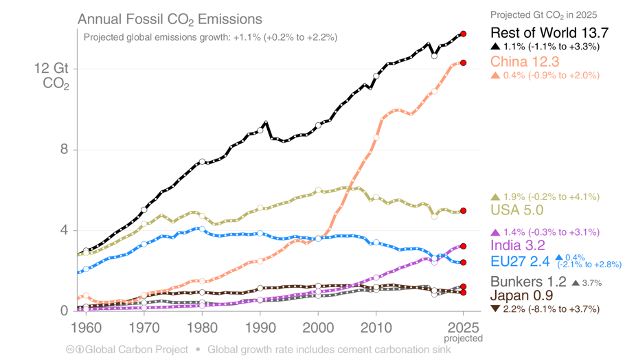
CO2 emissions by fossil fuel source
Top COAL
by large margon
by large margon
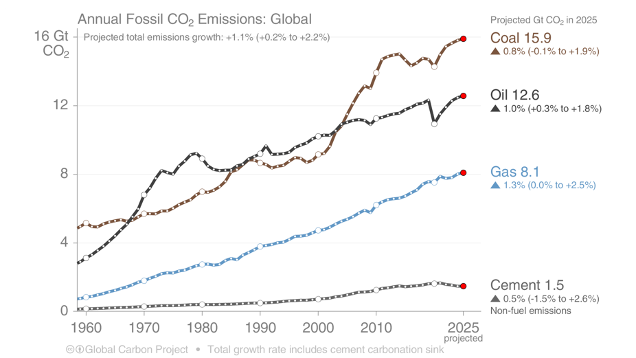
China emissions, as much as the rest of the world combined
CO2 emissions still increasing, with a linear increase from 1980.
For 1.5°C and for 2°C global emissions decline by 2020
Emissions are far above 1.5°C and 2°C limits, with a widening gap
For 1.5°C and for 2°C global emissions decline by 2020
Emissions are far above 1.5°C and 2°C limits, with a widening gap
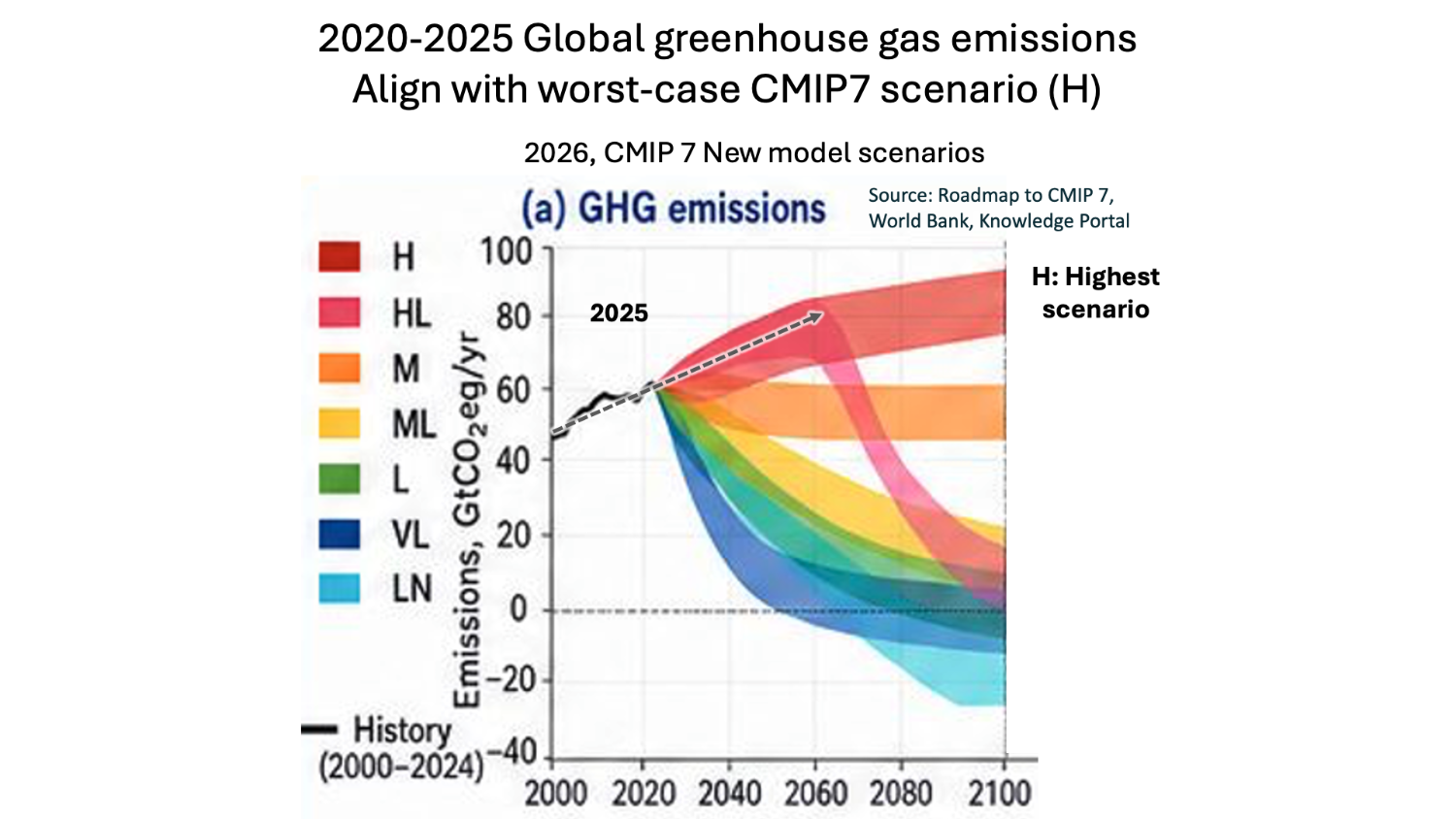
Greenhouse emissions are worst-case
By the new SMIP7 scenarios Global GHG emissions
align with the worst-case high emissions scenario (H)
By the new SMIP7 scenarios Global GHG emissions
align with the worst-case high emissions scenario (H)
Fossil fuels are well known as the main source of CO2, but are also a source of most of the greenhouse emissions. Black carbon (soot), mainly from fossil fuel combustion, is a global warming aerosols.
In 2024, the majority of GHG emissions consisted of fossil CO2, at 74.5%
CH4 methane 17.9% of emissions
N2O nitrous oxide 4.8% and
F-gases 2.8% (synthetic GHGs that include most potent and longest-lasting GHGs).
Global fossil CO2 emissions have increased by nearly 75% since 1990.
CH4 methane increased by nearly 30% and
N2O by 34.4% between 1990 and 2024, while
Fgases have seen a four-fold increase (+310.4%) over the same period.