Commitment
Climate Emergency Institute
The 2014 IPCC assessment estimated the commitment due to atmospheric greenhouse gases at 2.0°C. See signficant quoes below.
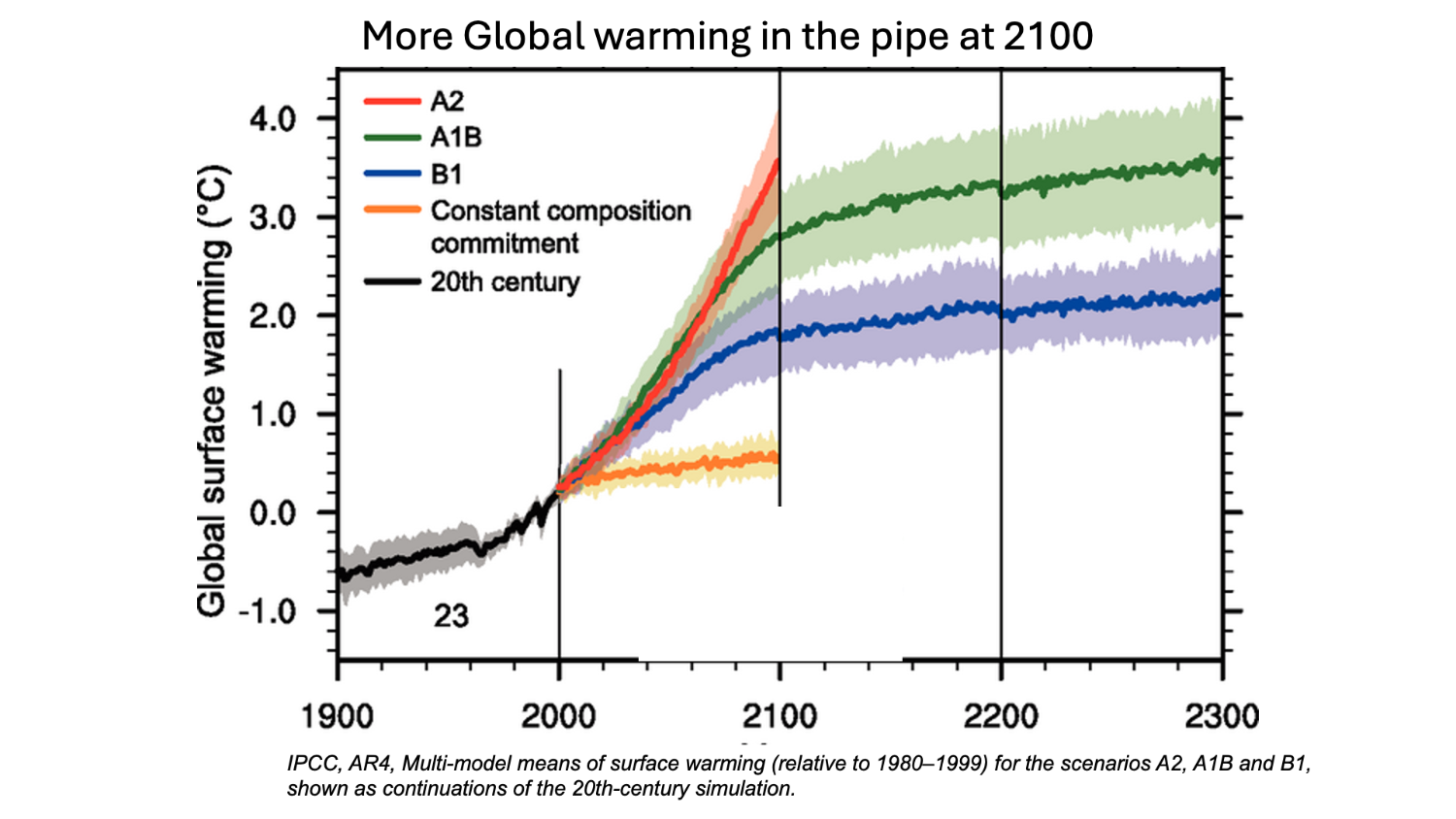
The commitment from constant greenhouse gas concentrations would correspond to approximately 2C warming IPCC AR5 WG1 Chapter 12, 12.5.2. page 1108.
The scientists now favour a ‘zero emissions commitment’ (ZEC)
It is defined as the further warming that would still occur if all future anthropogenic emissions of greenhouse gases and aerosol precursors were eliminated instantaneously. As this is impossible, it is a false misleading commitment.
It is defined as the further warming that would still occur if all future anthropogenic emissions of greenhouse gases and aerosol precursors were eliminated instantaneously. As this is impossible, it is a false misleading commitment.
Climate Sensitivity All commitment estimates are unrealistically low because they are based on a single climate sensitivity of 3°C, while under further warming sensitivity will increase with global warming increases and over time
NO assumed CO2 removal Any true definition of commitment does not include assumed successful CO2 removal which is not feasible today of the foreseeable future and in any case is not economically feasible without a large carbon tax on fossil fuel corporations.
Permafrost commitment (at 1°C) Permafrost is the largest single certain source of GHG feedback emissions caused by global surface warming, holding double atmospheric carbon. Permafrost thawing generates its own internal heat, making it irreversible. By a global warming of 1°C, Arctic permafrost feedback emissions of methane, CO2 and nitrous oxide are well established. Therefore a sustained warming of over 1.5°C, will eventually lead to irreversibly and increasing GHG permafrost feedback emissions.
The sea-ice decline amplifying feedback will further boost these GHG feedback emissions.
This requires emergency Arctic intervention.
Permafrost feedback is not included in IPCC temperature projections.
The sea-ice decline amplifying feedback will further boost these GHG feedback emissions.
This requires emergency Arctic intervention.
Permafrost feedback is not included in IPCC temperature projections.
2°C triggers hothouse Earth and climate change runaway due to activating multiple enormous sources of amplifying feedback.
The IPCC science warming projections are very large under-estimates.
1. Feedback extra emissions The large sources of GHG feedbacks caused by global surface warming, are not included in the IPCC temperature projections, which makes them policy misleading underestimates. Including just land carbon feedback by 2100 adds another 30% to 2100 warming (IPCC 2007 AR4)
2. Low climate sensitivity Also they all assume a single climate sensitivity (3C for 2X CO2) but there is a lot of research now pointing to 4.5°C and 6°C. That adds another 30% by 2100.
3. Only by 2100 Since the IPCC 2007 4th assessment projections have only been 2100, not to the full long term equilibrium warming long after 2100, which is at least another 75% added to the 2100 warming (even excluding feed-backs)
4. Unmasking aerosol cooling, is an extra warming from fossil fuel air pollution emissions (atmospheric aerosols) that cause cooling, because to stop global warming burning fossil fuels has to stop. The extra warming is 0.4-0.8°C (IPCC 2014 AR5)
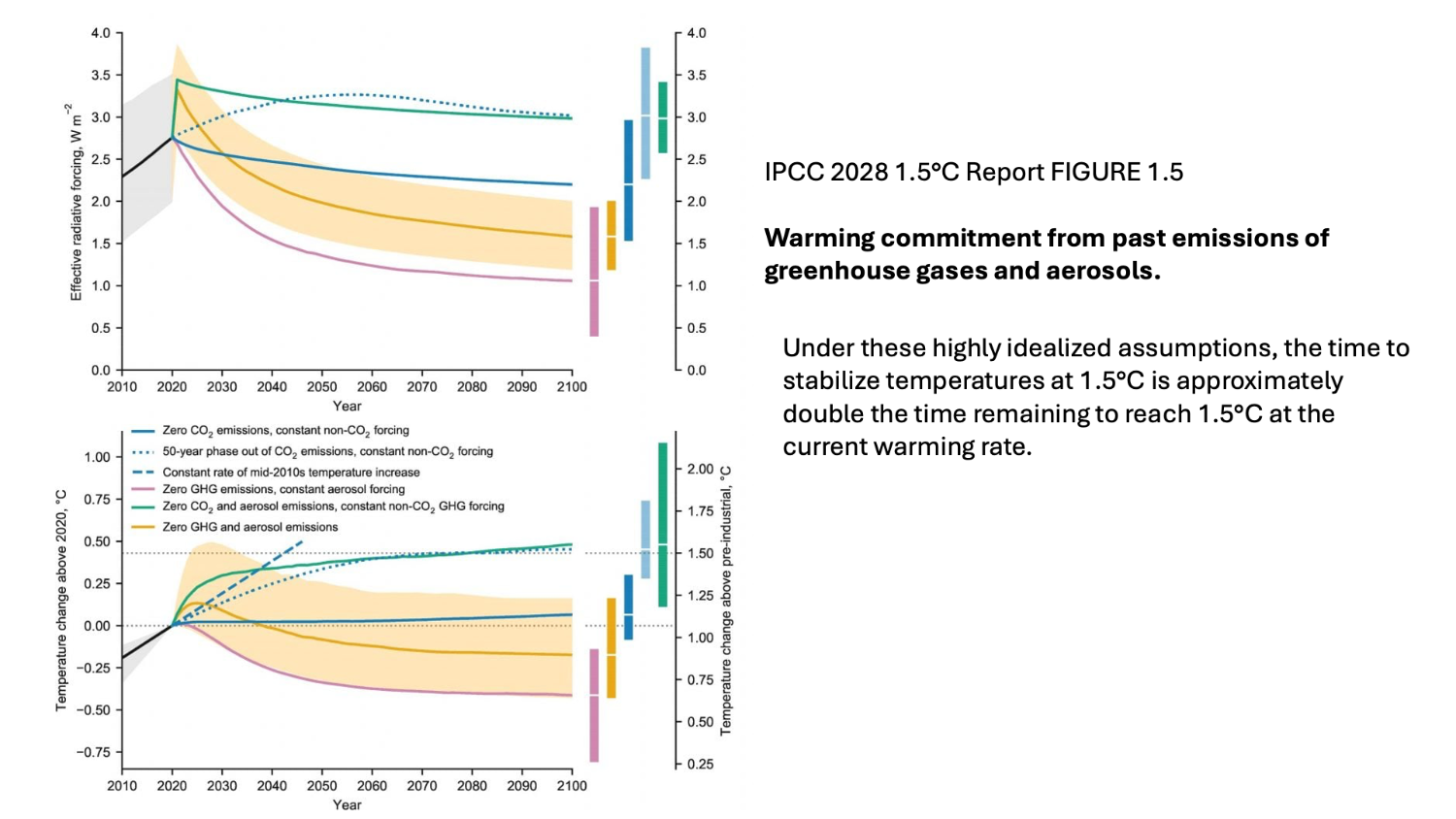
The 2018 IPCC 1.5°C Special Report claimed that it is possible
to limit warming to 1.5°C but this is only by 2100, and it only
applies with immediate rapid decline of global emissions
In the Report a 50 year phase out of all CO2 (1.5°C)
and aerosol emissions (0.4°C), leads to 1.9°C by 2100,
higher after 2100.
to limit warming to 1.5°C but this is only by 2100, and it only
applies with immediate rapid decline of global emissions
In the Report a 50 year phase out of all CO2 (1.5°C)
and aerosol emissions (0.4°C), leads to 1.9°C by 2100,
higher after 2100.
Inertias, lag times or delays contribute to the commitment of a very much higher warming than today. There is policy inertia (no action to put global emissions into decline), socio-economic, and development. Then, there is climate system science inertia.

The IPCC 2001 3rd assessment Policy implications of inertia p.18 explains this well
The scientific way to estimate climate system commitment is from radiative forcing and the atmospheric CO2 equivalent, which includes the temperature effect of all atmospheric greenhouse emissions to date.
Today's (2026) atmospheric CO2 equivalent is 539 ppm, NOAA Greenhouse Gas Index 2025,
'In terms of CO2 equivalents, the atmosphere in 2024 contained 539 ppm, while 422.8 is CO2 alone.
This is a long term equilibrium commitment of 2.6°C. (on sensitivity of 3°C)
Today's (2026) atmospheric CO2 equivalent is 539 ppm, NOAA Greenhouse Gas Index 2025,
'In terms of CO2 equivalents, the atmosphere in 2024 contained 539 ppm, while 422.8 is CO2 alone.
This is a long term equilibrium commitment of 2.6°C. (on sensitivity of 3°C)
Jan 2021 research :commitment by 2100 is over 1.5°C
full equilibrium warming is over 2°C
IPCC 2014 AR5 WG1 Chapter 12 (p.1108) on commitment (2012 data) said essentially the same.
Going by radiative forcing it was 'about 2°C' at 2012.
full equilibrium warming is over 2°C
IPCC 2014 AR5 WG1 Chapter 12 (p.1108) on commitment (2012 data) said essentially the same.
Going by radiative forcing it was 'about 2°C' at 2012.

UK Met Office July 2019 Links between emissions pathways and time lags in Earth’s climate system

2020, C. Huntingford CMIP6 models imply high committed warming
Sources There are many sources of climate science commitment that increase with temperature:
o Ocean thermal intertia
o Extreme long atmospheric CO2 lifetime
o Feedbacks -terrestrial (soil & vegetation),
forest dieback, peatlands, permafrost,
o Failing carbon sinks
o Air pollution acid aerosols (cooling)
Air pollution regulation is already boosting acceleration
of global warming.
o Ocean thermal intertia
o Extreme long atmospheric CO2 lifetime
o Feedbacks -terrestrial (soil & vegetation),
forest dieback, peatlands, permafrost,
o Failing carbon sinks
o Air pollution acid aerosols (cooling)
Air pollution regulation is already boosting acceleration
of global warming.
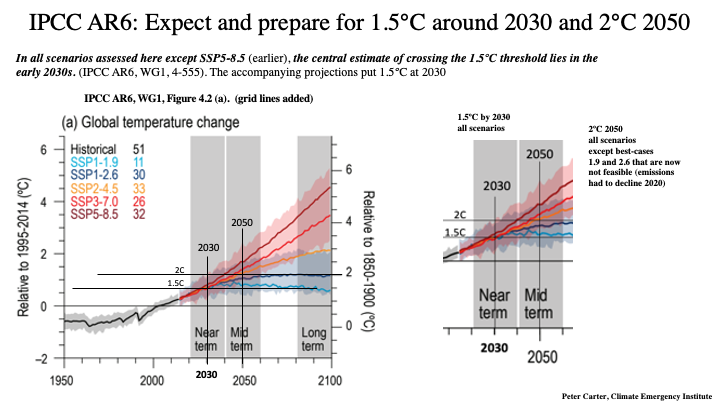
'In all scenarios assessed here the central estimate of crossing the 1.5°C threshold lies in the early 2030s.'
(IPCC AR6, WG1, 4-555)
(IPCC AR6, WG1, 4-555)
Future global surface heating and climate change commitment (much higher than today's) is the most important and most ignored aspect of the science.
It is essential information in policy making.
It is essential information in policy making.
Definition There is actually no agreed on scientific definition of commitment
The IPCC gives several examples but they are all incomplete.
The (instant) zero emissions commitment (now routinely used) is only for modelling, has no policy relevance and is misleading in assessments.
The constant composition (constant atmospheric GHGs) is useful but incomplete.
The IPCC gives several examples but they are all incomplete.
The (instant) zero emissions commitment (now routinely used) is only for modelling, has no policy relevance and is misleading in assessments.
The constant composition (constant atmospheric GHGs) is useful but incomplete.
Today (2026) according to IPCC science, the world is absolutely committed to an unavoidable globally disastrous warming of 1.5°C by 2030 (IPCC AR6)
The IPCC says assessments have long shown that to avoid the global and planetary catastrophic 2°C, global emissions have to decline by 2020. IPCC AR6 puts it a 2020-2025 at the latest, whith immedaiye action
Today with emissions still being increased the world is committed to 2°C and more
Today with emissions still being increased the world is committed to 2°C and more
All relevant versions of commitment puts the world above 2°C
The IPCC acknowledges commitment, but has no single definition of commitment.
In practical terms for mitigation, there are two big commitment sources- Policy and Climate science.
Policy commitment by 2100 from IPCC AR6 is 3.2C°C, which is much higher after 2100.
Climate science commitment is 2.4°C by 2100, from radiative heat forcing, again much higher after 2100
(J. Hansen et al, 2023, Global Warming in the pipeline)
In practical terms for mitigation, there are two big commitment sources- Policy and Climate science.
Policy commitment by 2100 from IPCC AR6 is 3.2C°C, which is much higher after 2100.
Climate science commitment is 2.4°C by 2100, from radiative heat forcing, again much higher after 2100
(J. Hansen et al, 2023, Global Warming in the pipeline)

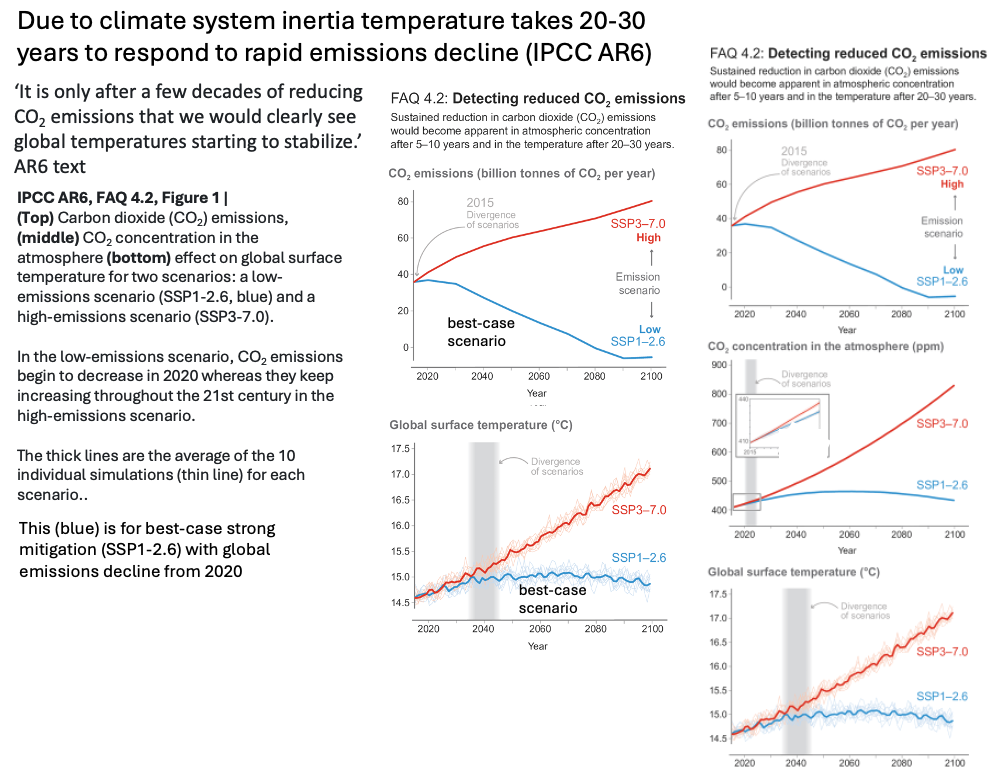
Climate system inertia is mainly from the very long atmospheric life-time of CO2 as well as the ocean heat lag.
Even with best-case strong mitigation it takes 20 to 30 years for temperature stabilization to show by slowing of warming
(IPCC AR6, WG3,Ch4.
Even with best-case strong mitigation it takes 20 to 30 years for temperature stabilization to show by slowing of warming
(IPCC AR6, WG3,Ch4.
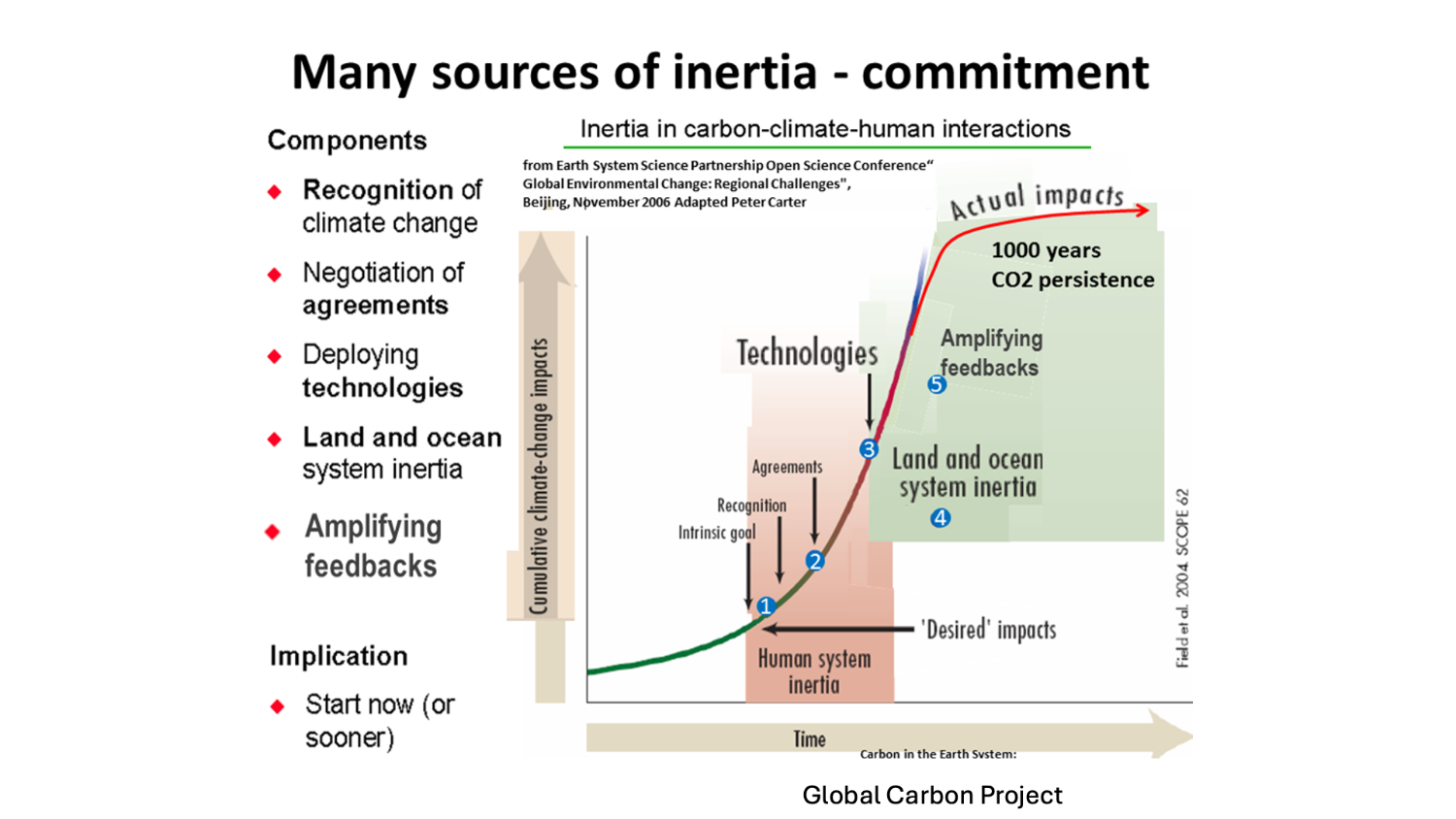
On commitment by the science, the climate system is characterized by its great inertia and so momentum.
A metaphor is that a large container ship takes up to a mile to be stopped.
A metaphor is that a large container ship takes up to a mile to be stopped.
IPCC AR6 on Commitment
pdf download
pdf download
Commitment has been described as locked in, burnt it and in the pipe. It can calculated from atmospheric CO2q. and radiative forcing.
From radiative forcing the Hansen at al 2023 Global warming in the pipeline found radiative forcing total warming including in the pipe is 2.4°C.
From radiative forcing the Hansen at al 2023 Global warming in the pipeline found radiative forcing total warming including in the pipe is 2.4°C.
Climate change assessment should assess impacts at total committed warming, and mitigation should be based on practical commitment, including especially policy.
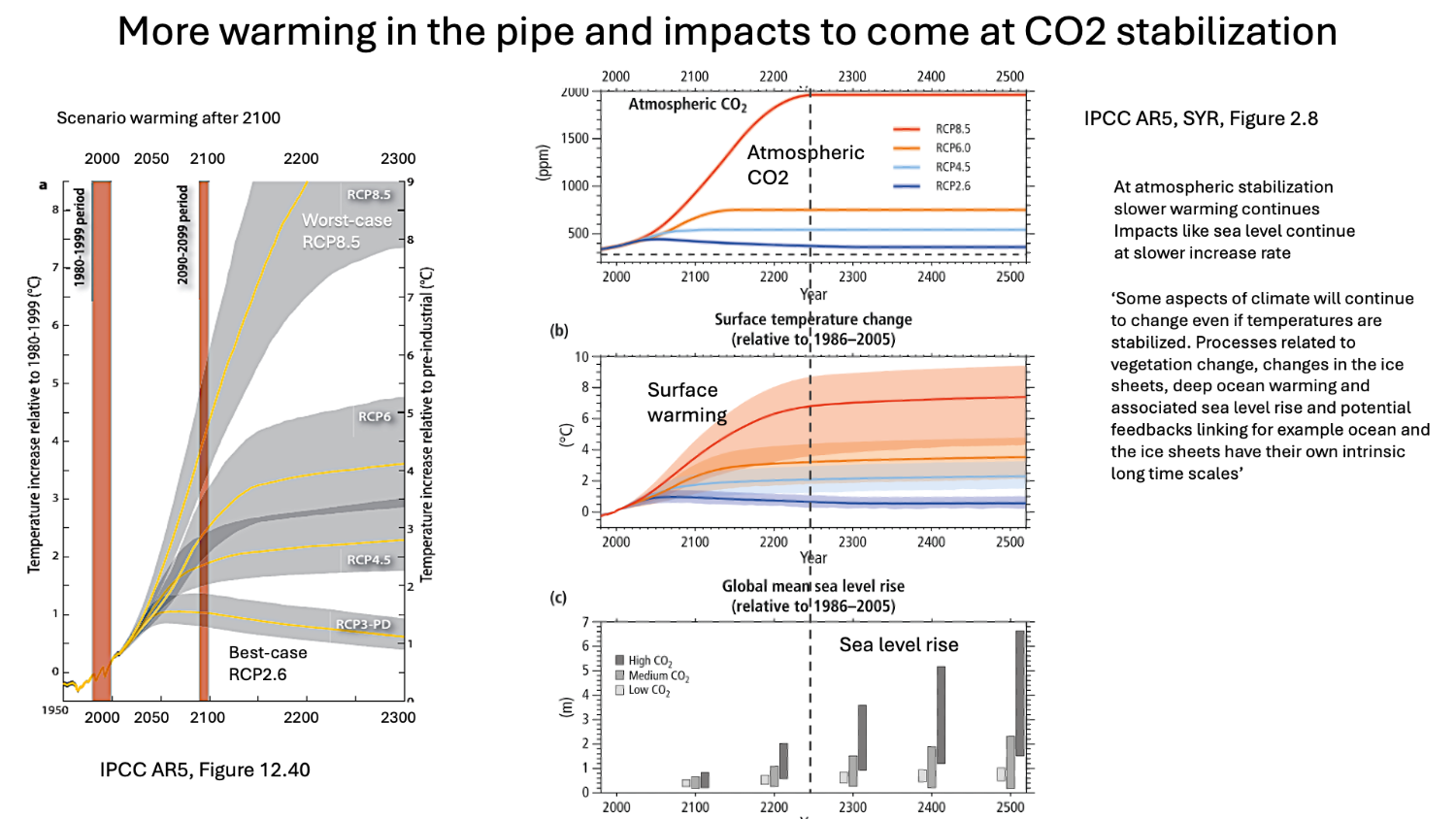
IPCC AR6, COMMITMENT Even with best-case strong mitigation, it takes 20-30 years for warming to stabilize
Double click here to edit this text.
The fact is (2026) that we are at 1.5°C. Coperinicus:'G lobal surface temperatures over the 2023–2025 period averaged more that 1.5°C